# AI-Generated Code Quality: Why Faster Development Is Creating New Engineering Risks

> AI coding tools are increasing how much software teams can produce. Research from Faros AI and New Relic shows that extra output is also putting new pressure on code review, quality assurance, and production.

- Published: October 28, 2026
- Author: Ardan Labs
- URL: https://www.ardanlabs.com/news/2026/ai-generated-code-quality-why-faster-development-is-creating-new-engineering-risks/

AI coding tools are changing the pace of software development. Teams can complete more tasks, generate larger implementations, and move changes through development pipelines faster than before.

But that additional output creates a practical challenge. Every change still needs to be integrated, validated, and supported in production. Those responsibilities don't automatically become easier because the code was generated faster.

Consider an engineering team that increases its development throughput by 30% after adopting AI coding tools. The productivity dashboard looks promising. Meanwhile, the same engineers are handling a growing queue of pull requests, investigating integration failures, and supporting an expanding codebase.

The team may be producing more software without having the capacity to process it effectively.

Recent research from Faros AI and New Relic offers a closer look at this problem. The findings show measurable productivity gains alongside rising pressure on code review, quality assurance, and production operations.

More interestingly, newer research suggests that some of the initial problems associated with AI adoption are improving, while other bottlenecks are becoming more pronounced.

**The challenge for engineering organizations is understanding where the work is moving and whether their existing processes can keep up.**

---

## AI Coding Productivity Is Increasing, but So Are Engineering Risks

In April 2026, Faros AI published its <a href="https://www.faros.ai/research/ai-acceleration-whiplash" target="_blank" rel="noopener noreferrer">AI Engineering Impact Report: The Acceleration Whiplash</a>.

The research examined two years of engineering telemetry from approximately 22,000 developers across more than 4,000 teams. Rather than relying on developer perceptions, Faros analyzed activity across version control, CI/CD systems, work management tools, and incident records.

The results showed substantial increases in development activity as AI adoption grew.

Task throughput per developer increased 33.7%, completed epics per developer rose 66.2%, and pull requests merged per developer increased 16.2%.

Those improvements are significant. But the same analysis found changes in quality and operational metrics.

<div class="not-prose my-8 rounded-2xl border-2 border-base-300 bg-base-200/40 overflow-hidden">
  <div class="overflow-x-auto">
    <table class="table table-zebra table-sm md:table-md w-full min-w-[36rem]">
      <caption class="sr-only">Engineering metrics and the change reported by Faros in Q2 2026</caption>
      <thead>
        <tr class="bg-neutral text-base-100">
          <th class="font-semibold" scope="col">Engineering Metric</th>
          <th class="font-semibold text-right" scope="col">Change Reported by Faros, Q2 2026</th>
        </tr>
      </thead>
      <tbody>
        <tr>
          <td class="font-medium">Tasks completed per developer</td>
          <td class="text-right font-semibold tabular-nums">+33.7%</td>
        </tr>
        <tr>
          <td class="font-medium">Epics completed per developer</td>
          <td class="text-right font-semibold tabular-nums">+66.2%</td>
        </tr>
        <tr>
          <td class="font-medium">Bugs per developer</td>
          <td class="text-right font-semibold tabular-nums">+54%</td>
        </tr>
        <tr>
          <td class="font-medium">Incidents relative to merged pull requests</td>
          <td class="text-right font-semibold tabular-nums">+242.7%</td>
        </tr>
        <tr>
          <td class="font-medium">Code churn</td>
          <td class="text-right font-semibold tabular-nums">+861%</td>
        </tr>
        <tr>
          <td class="font-medium">Pull requests merged without review</td>
          <td class="text-right font-semibold tabular-nums">+31.3%</td>
        </tr>
      </tbody>
    </table>
  </div>
</div>

The incidents-to-pull-requests ratio is particularly noteworthy.

A 242.7% increase means substantially more production incidents were recorded relative to the number of pull requests merged. It doesn't establish that an individual pull request became three times more likely to cause an incident, since the metric doesn't directly attribute each incident to a particular change.

Still, it raises an operational concern. Development activity was increasing, but production stability wasn't improving alongside it.

These findings are observational, not proof that AI directly caused the changes. Organizations adopting AI more aggressively may also differ in workload, delivery pressure, and engineering practices.

**What the research establishes is a pattern worth investigating: higher development throughput can coexist with deteriorating operational metrics.**

---

## More Code Doesn't Always Mean More Engineering Progress

One of the most striking findings in the original Faros report was an 861% increase in code churn. Faros measures churn as the ratio of lines deleted to lines added for merged code during a quarter. A large increase indicates considerably more code removal relative to new additions.

That isn't automatically a negative outcome.

Removing unnecessary code, simplifying implementations, and replacing outdated functionality can improve a system. AI tools may make this type of work easier. But churn can also reflect repeated corrections, unsuccessful implementations, or changes that require substantial revision after integration.

The metric doesn't distinguish between these outcomes. That distinction matters because the same research also found increases in bugs and production incidents.

Consider a feature that an AI agent implements in an afternoon. The initial tests pass, the change is merged, and the task is completed. Later, integration testing reveals that the implementation doesn't handle a downstream service failure correctly. Another engineer investigates, modifies the code, adds coverage, and sends the change through review again.

The implementation was completed quickly. The feature itself required considerably more work. This is where measuring engineering productivity becomes difficult. A completed task represents progress in a workflow, but it doesn't necessarily capture the total effort required to deliver and maintain the functionality.

The Faros findings don't tell us exactly how much of the increased churn represents avoidable rework. They do, however, provide a reason to examine whether higher throughput is translating into lasting improvements.

For engineering leaders, that means looking beyond completed tasks to understand what happens after the work is marked done.

---

## AI-Generated Code Looks Good in Review. Production Tells a Different Story.

The Faros findings become more interesting when compared with independent research.

In June 2026, New Relic published its <a href="https://newrelic.com/resources/report/2026-state-of-ai-coding" target="_blank" rel="noopener noreferrer">2026 State of AI Coding Report</a>, based on a survey of 200 U.S. technology decision makers at organizations using generative or agentic AI.

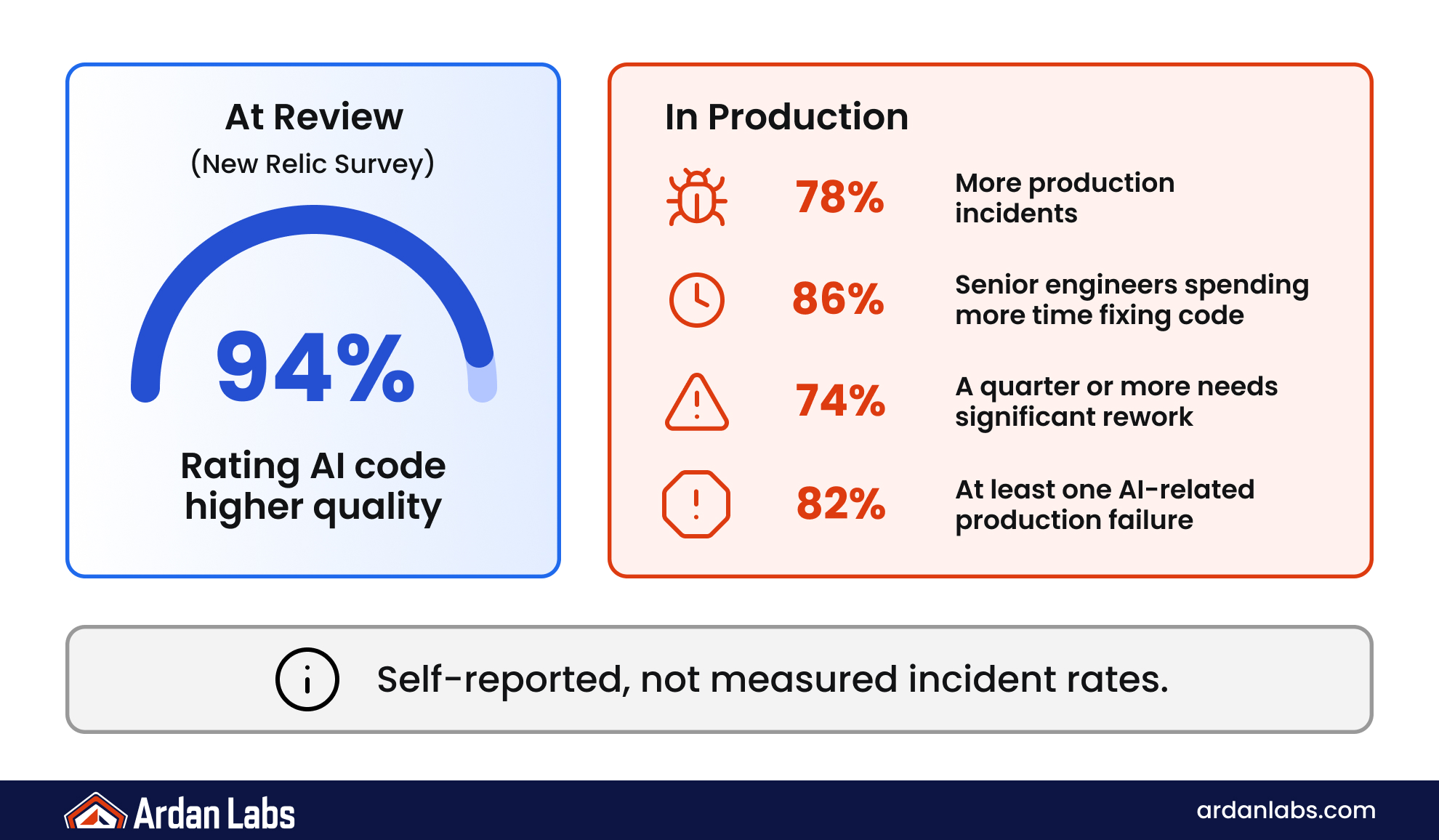
**One finding stands out: 94% of respondents rated AI-generated code as higher quality than human-authored code at the time of review.**

Yet those same organizations reported challenges after deployment.

According to the survey:

- **78% reported an increase in production incidents.**
- **86% reported senior engineers spending more time fixing code.**
- **74% estimated that at least a quarter of their AI-generated code required significant rework.**
- **82% reported experiencing at least one production failure associated with AI-generated code during the previous six months.**

Unlike Faros's engineering telemetry, these figures reflect respondents' reported experiences. They shouldn't be interpreted as independently measured incident rates. Nevertheless, the contrast raises an interesting question:

**What are reviewers evaluating when they describe AI-generated code as higher quality?**

Readable code, consistent naming, and familiar implementation patterns can make a change easier to understand. But those characteristics don't necessarily establish how the implementation will behave under production conditions.

A database operation might work correctly under normal traffic but introduce contention at higher concurrency. A retry mechanism might recover from an isolated failure while overwhelming a downstream service during a larger outage.

These problems can exist in human-authored code as well. The difference with AI-assisted development is the speed and volume at which implementations can now be produced. When more changes arrive in less time, teams have to decide how much verification is sufficient and where to concentrate their attention.

The New Relic findings suggest that organizations may be more confident in the code they're reviewing than their subsequent production experiences justify. That gap between perceived quality and observed reliability deserves closer examination.

<img src="/images/news/ai-generated-code-looks-good-in-review.jpg" alt="At review, 94% of New Relic survey respondents rate AI-generated code as higher quality. In production, 78% report more incidents, 86% say senior engineers spend more time fixing code, 74% say at least a quarter needs significant rework, and 82% report at least one AI-related production failure. These figures are self-reported, not measured incident rates." class="w-full max-w-4xl mx-auto rounded-lg border-2 border-base-300" loading="lazy" decoding="async" />

---

## Six Months Later, the Engineering Bottleneck Is Moving

Faros's newer Q3 2026 report, <a href="https://www.faros.ai/research/speed-trap" target="_blank" rel="noopener noreferrer">The Speed Trap</a>, provides an important update to the original findings. The follow-up examines engineering telemetry as organizations deepen their AI adoption. Its results are particularly interesting because they don't show every metric continuing to deteriorate.
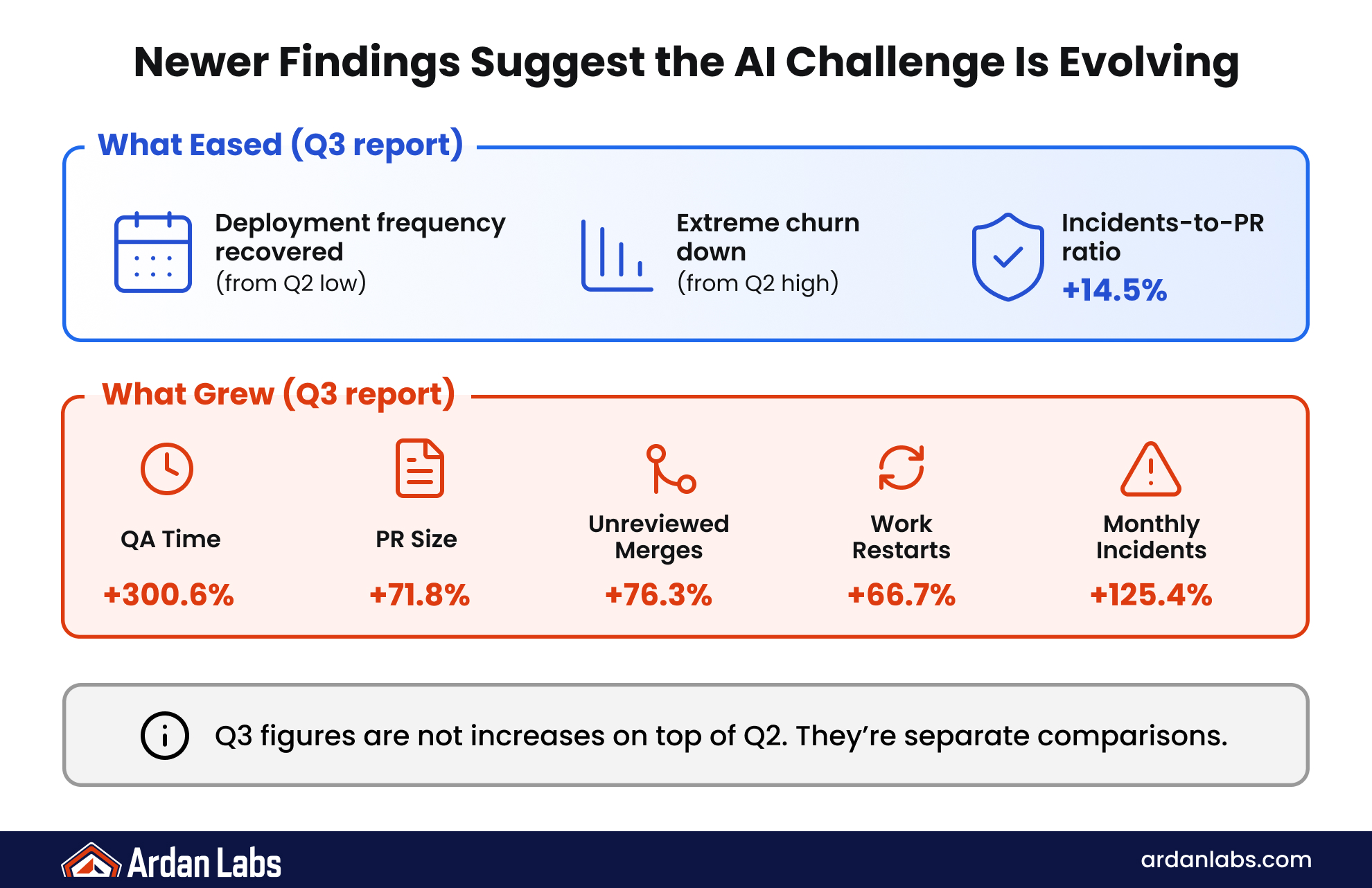
Some outcomes improved. Deployment frequency recovered, and the extreme code churn observed during the earlier adoption period declined substantially.

The incidents-to-pull-requests metric also improved. The original report identified a 242.7% increase, while the newer analysis reported a 14.5% increase within its own comparison.

The reports use different analytical comparisons, so these figures shouldn't be treated as a direct before-and-after measurement. Still, the newer findings suggest that some of the difficulties associated with AI adoption may ease as organizations adjust their workflows.

Other metrics tell a different story.

<div class="not-prose my-8 rounded-2xl border-2 border-base-300 bg-base-200/40 overflow-hidden">
  <div class="overflow-x-auto">
    <table class="table table-zebra table-sm md:table-md w-full min-w-[36rem]">
      <caption class="sr-only">Engineering metrics and the Q3 2026 Faros finding for each</caption>
      <thead>
        <tr class="bg-neutral text-base-100">
          <th class="font-semibold" scope="col">Engineering Metric</th>
          <th class="font-semibold text-right" scope="col">Q3 2026 Faros Finding</th>
        </tr>
      </thead>
      <tbody>
        <tr>
          <td class="font-medium">Average pull request size</td>
          <td class="text-right font-semibold tabular-nums">+71.8%</td>
        </tr>
        <tr>
          <td class="font-medium">Pull requests merged without review</td>
          <td class="text-right font-semibold tabular-nums">+76.3%</td>
        </tr>
        <tr>
          <td class="font-medium">Time spent in QA</td>
          <td class="text-right font-semibold tabular-nums">+300.6%</td>
        </tr>
        <tr>
          <td class="font-medium">Work restarts</td>
          <td class="text-right font-semibold tabular-nums">+66.7%</td>
        </tr>
        <tr>
          <td class="font-medium">Monthly production incidents</td>
          <td class="text-right font-semibold tabular-nums">+125.4%</td>
        </tr>
        <tr>
          <td class="font-medium">Incidents relative to merged pull requests</td>
          <td class="text-right font-semibold tabular-nums">+14.5%</td>
        </tr>
      </tbody>
    </table>
  </div>
</div>

**These figures represent changes within the Q3 report's analytical framework, not percentage increases from the Q2 results.**

The 300.6% increase in time spent in QA is especially revealing.

Development work may be moving faster, but verification is consuming substantially more time. Larger pull requests also require reviewers to understand more changes before deciding whether they're ready to merge.

At the same time, the number of pull requests merged without any review, whether human or agentic, increased 76.3% relative to the study's comparison baseline. This is a relative increase, not the percentage of all pull requests that were unreviewed.

Together, these findings suggest that some of the pressure created by faster implementation is shifting into verification and integration.

But perhaps the most important distinction is between incident ratios and total incident volume. While incidents relative to merged pull requests improved substantially compared with the earlier research, the newer report still found a 125.4% increase in monthly production incidents.

These metrics measure different aspects of operational performance.

An organization may be handling individual changes more effectively while still experiencing more incidents overall because the volume of activity has grown.

For a CTO, that difference matters.

An improving change failure metric is encouraging, but the engineers responding to incidents still have to manage the total operational workload.

**The newer Faros findings suggest that the challenge is evolving. Some aspects of AI-assisted delivery are becoming more efficient, while QA, review, and operational capacity remain under pressure.**

<img src="/images/news/six-months-later-the-engineering-bottleneck-is-moving.jpg" alt="Newer findings suggest the AI challenge is evolving. What eased in the Q3 report: deployment frequency recovered from the Q2 low, extreme churn is down from the Q2 high, and the incidents-to-pull-request ratio is up 14.5%. What grew: QA time up 300.6%, pull request size up 71.8%, unreviewed merges up 76.3%, work restarts up 66.7%, and monthly incidents up 125.4%. Q3 figures are separate comparisons, not increases on top of the Q2 results." class="w-full max-w-4xl mx-auto rounded-lg border-2 border-base-300" loading="lazy" decoding="async" />

---

## Why AI Code Review Is Becoming an Engineering Bottleneck

Code review is one area where the changing distribution of engineering work becomes visible.

When a developer writes an implementation manually, much of the reasoning behind it develops alongside the code. Requirements are explored, design decisions are made, and potential problems are considered during implementation.

With AI coding agents, substantial changes can be generated before the developer has examined every decision involved. That changes the review process.

A reviewer may need to reconstruct the reasoning behind an implementation rather than simply evaluate changes made by someone who can explain each decision.

Why was a particular dependency introduced? Does the implementation preserve existing behavior? What assumptions does it make about data consistency or failure recovery?

These questions become more difficult as the size of a change increases.

Faros's Q3 findings show average pull request size increasing 71.8%. Larger changes can require more time to understand, particularly when they affect multiple components or introduce unfamiliar patterns.

The challenge isn't necessarily that reviewers lack the technical ability to evaluate the code. It's that the amount of work arriving for review may exceed the time available to evaluate it thoroughly. That creates an incentive to reduce review depth, delay feedback, or rely more heavily on automated checks.

The newer Faros research also offers a potential way forward. Teams making extensive use of agentic code review showed improvements in certain downstream metrics, including faster initial reviews and lower change failure rates. Those findings are correlational, so they don't establish that agentic review alone produced the improvements. But they suggest that AI-assisted verification may help organizations manage the increased volume of changes.

The important question is how that verification is structured. A routine documentation update doesn't require the same level of scrutiny as a change to transaction processing or authentication logic. Organizations can use automated checks for predictable issues while directing deeper review toward changes with greater operational consequences. That requires clear standards for review scope, automated validation, and escalation.

Simply adding another AI reviewer to every pull request won't necessarily solve the problem. Teams need to understand which checks provide useful evidence and which decisions still require deeper investigation.

---

## Why Engineering Judgment Matters More as AI Adoption Increases

The review challenges identified by Faros point toward a broader issue: understanding a change requires understanding the system it affects.

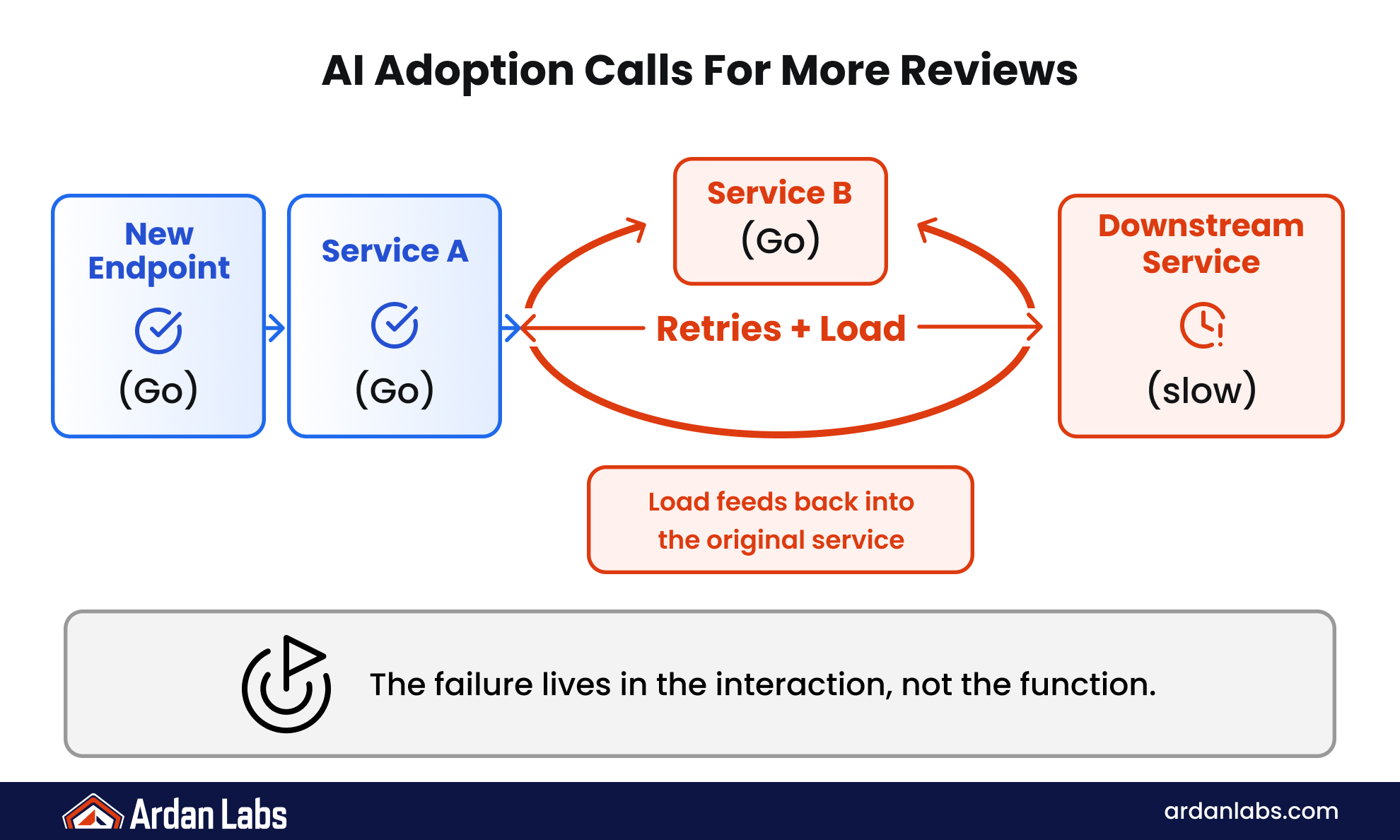
Consider a Go service that communicates with several downstream dependencies. An AI agent generates a new endpoint, adds request handling, implements database operations, and produces unit tests. Everything compiles, and the tests pass. But the implementation introduces retries without accounting for the downstream service's capacity.

During normal operation, the behavior appears correct. When the dependency begins responding slowly, concurrent requests trigger additional retries, increasing load on an already struggling service.

The failure isn't necessarily visible in the individual functions. It emerges from the interaction between components.

A reviewer needs to understand the service's timeout policies, concurrency behavior, and failure recovery strategy to recognize the risk. This is an example of why validation becomes more complex as AI-assisted development expands. The code can satisfy the immediate task while creating behavior that conflicts with the larger system's operational requirements.

The engineering challenge is identifying those conflicts before deployment. That doesn't mean every AI-generated change requires an extensive architectural review. It means teams need a reliable way to identify changes whose consequences extend beyond the local implementation.

In distributed systems, those consequences can involve resource contention, cascading failures, inconsistent state, or unexpected interactions between services. The value of experienced engineering expertise lies in recognizing which assumptions need to be tested and which failure modes deserve attention.

For organizations increasing their use of AI coding agents, this expertise becomes especially important when establishing review requirements, designing integration tests, and deciding which changes can safely move through automated workflows.
<img src="/images/news/engineering-judgment-matters-more-as-ai-adoption-increases.jpg" alt="AI adoption calls for more reviews. A new Go endpoint and Service A both pass their checks, then retries and extra load circulate between Service B and a slow downstream service and feed back into the original service. The failure lives in the interaction, not the function." class="w-full max-w-4xl mx-auto rounded-lg border-2 border-base-300" loading="lazy" decoding="async" />

---

## How Engineering Leaders Can Turn AI Productivity Into Reliable Software

The Faros and New Relic findings give engineering leaders several practical areas to investigate.

The goal isn't to reduce AI adoption or introduce unnecessary approval processes. It's to identify where additional development output is creating pressure and adjust the workflow accordingly.

### 1. Measure Engineering Outcomes, Not Just Development Activity

Start by comparing delivery activity with operational results.

If completed tasks and merged pull requests are increasing, examine whether production incidents, work restarts, or review delays are changing at the same time.

Avoid interpreting a single metric in isolation.

For example, a higher code churn rate may reflect productive refactoring or repeated corrections. A lower incident-to-pull-request ratio may coexist with a higher total number of incidents.

The useful question is whether the organization is delivering more functionality without a disproportionate increase in the effort required to maintain it. Tracking throughput alongside change failure rate, incident volume, review latency, and time to restore service can help reveal where the additional work is accumulating.

### 2. Strengthen Validation Before Problems Reach Production

Verification should begin before an implementation reaches the final review stage.

For changes involving external dependencies, concurrency, data integrity, or security-sensitive functionality, teams should establish the expected behavior and failure conditions before generating code. Those requirements can inform automated tests and acceptance criteria.

Integration tests should verify how components interact, while performance and failure testing can expose behavior that ordinary unit tests miss.

Production observability provides another important layer.

<a href="https://newrelic.com/blog/ai/state-of-ai-coding-2026" target="_blank" rel="noopener noreferrer">New Relic</a> found that 96% of surveyed technology leaders considered observability very or extremely important when working with AI-generated code. Logs, metrics, and traces help engineers investigate behavior that wasn't anticipated during development and determine whether a change is operating as expected.

### 3. Keep Changes Understandable and Reviewable

The increase in average pull request size identified by Faros deserves attention.

Larger changes aren't automatically lower quality, but they can make review more difficult and increase the amount of context needed to understand an implementation. Teams can address this by defining expectations around pull request scope.

Where practical, implementations should be divided into changes that can be reviewed and validated independently. This makes it easier to identify the source of a problem, evaluate dependencies, and understand what a change introduces.

The objective isn't to impose an arbitrary limit on every pull request. It's to prevent implementation speed from creating changes that are unnecessarily difficult to evaluate.

### 4. Use AI to Improve Review, Not Just Code Generation

AI-assisted review offers an opportunity to reduce repetitive verification work. Automated reviewers can identify common issues, check changes against established standards, and flag areas that may require closer examination.

The Q3 Faros findings suggest that teams using agentic review extensively may experience improvements in some delivery and quality metrics. Organizations should evaluate these tools based on the issues they catch, the false positives they generate, and whether they improve review effectiveness.

For example, an automated reviewer that repeatedly flags formatting issues already handled by a linter may add little value. A reviewer that identifies a missing error path or highlights a change affecting a critical interface may be more useful.

The goal is to make review more effective, not simply automate approval.

### 5. Preserve Engineering Expertise Where It Creates the Most Value

The increase in QA time and work restarts suggests that engineering organizations should examine how their teams are allocating technical expertise.

If experienced engineers spend most of their time resolving integration problems or investigating incidents, less capacity remains for design work and preventive improvements. That can create a cycle in which teams respond to problems without addressing the conditions producing them.

Engineering leaders should identify where specialized expertise is becoming a bottleneck. That might involve reviewing changes to critical services, improving test infrastructure, resolving architectural inconsistencies, or helping teams establish safer deployment practices.

The answer will vary by organization.

What matters is understanding where engineering capacity is constrained rather than assuming that faster implementation automatically increases the team's ability to deliver.

---

## Scaling Engineering Capability Alongside AI

The research highlights a capacity planning challenge for organizations adopting AI-assisted development. Implementation throughput can increase without a corresponding improvement in the processes responsible for integrating and operating that work. For some teams, the immediate need may be better automation or testing infrastructure. Others may need to address architectural complexity, review practices, or gaps in specialized engineering expertise.

At Ardan Labs, we help organizations address these challenges through <a href="/consulting/">engineering consulting</a>, <a href="/ai/">AI implementation</a>, and experienced engineers who integrate directly into existing teams.

Our <a href="/staff-augmentation/">Staff Augmentation</a> services provide engineers with production experience in Go, Rust, Kubernetes, and distributed systems. They work alongside internal teams to support development, address technical challenges, and help maintain the standards required for reliable software.

For organizations increasing their use of AI coding tools, that expertise can help strengthen the engineering processes surrounding implementation, particularly where existing teams are managing growing workloads or complex production environments.

The right solution depends on where the constraint exists.

Adding development capacity won't resolve an ineffective review process on its own. Likewise, stronger automation may not address an underlying architectural problem.

Understanding that distinction is an important part of scaling engineering organizations effectively.

---

## The Next AI Productivity Advantage Is Reliable Engineering

The Faros research shows that the effects of AI adoption are changing as organizations gain experience.

Some of the initial quality concerns appear to be easing. Deployment performance is recovering, and certain incident metrics have improved. At the same time, larger pull requests, longer QA cycles, and higher total incident volumes suggest that engineering teams are still adapting to the additional output.

That makes the next phase of AI adoption less about proving that coding tools can increase productivity and more about understanding how that productivity affects the entire development lifecycle.

For engineering leaders, the opportunity is to identify where additional work is accumulating and address those constraints before they become persistent operational problems.

The next meaningful improvement in AI-assisted development may come from reducing the effort between generating a change and confidently operating it in production.

That's where the latest research suggests engineering organizations still have substantial room to improve.

---

<div class="not-prose bg-neutral text-base-100 px-8 pb-12 pt-4 rounded-lg border-2 shadow-xl space-y-4">
<img src="/images/al-emblem.svg" class="mb-1 mt-0 py-3" alt="Ardan Labs Emblem"/>

<p class="text-xl font-bold">Is your engineering team keeping pace with AI-assisted development?</p>

<p><a href="/contact/" class="link text-base-100 hover:text-primary"><strong>Talk with Ardan Labs</strong></a> about strengthening your engineering capabilities, improving production reliability, and scaling development with experienced engineers who understand the systems behind the code.</p>

<div class="flex flex-wrap gap-3 pt-2">
<a href="/ai/" class="btn btn-primary shadow-none rounded-xl text-lg">AI Implementations</a>
<a href="/staff-augmentation/" class="btn bg-base-100 text-neutral hover:bg-primary hover:text-base-100 border-none shadow-none rounded-xl text-lg">AI-Ready Engineers</a>
</div>
</div>

---

## Sources and Further Reading

**Primary Research**

**Faros AI**

- <a href="https://www.faros.ai/research/ai-acceleration-whiplash" target="_blank" rel="noopener noreferrer">The AI Engineering Impact Report 2026: The Acceleration Whiplash</a> (<a href="https://pages.faros.ai/hubfs/AI_Engineering_Report_2026_The_Acceleration_Whiplash_Faros.pdf" target="_blank" rel="noopener noreferrer">PDF</a>). Original Q2 2026 research examining AI adoption, engineering throughput, code quality, review processes, and production incidents.
- <a href="https://www.faros.ai/blog/ai-acceleration-whiplash-takeaways" target="_blank" rel="noopener noreferrer">Ten Takeaways From the AI Engineering Report 2026: The Acceleration Whiplash</a>. Detailed explanation of the original report's findings and methodology.
- <a href="https://www.faros.ai/research/speed-trap" target="_blank" rel="noopener noreferrer">The Speed Trap: Q3 2026 AI Engineering Report</a>. Updated research examining engineering outcomes as organizations deepen their use of AI coding tools.
- <a href="https://www.faros.ai/blog/ai-speed-trap-takeaways" target="_blank" rel="noopener noreferrer">The Speed Trap: Eight Takeaways From Faros's Latest AI Engineering Research</a>. Summary of the Q3 findings, including review gaps, QA delays, deployment improvements, incident trends, and agentic review.
- <a href="https://www.faros.ai/research" target="_blank" rel="noopener noreferrer">Faros AI Research Hub</a>. Additional research on engineering productivity and AI adoption.
- <a href="https://www.faros.ai/blog/ai-code-quality-mirage" target="_blank" rel="noopener noreferrer">The AI Code Quality Mirage: What New Relic's Research Reveals</a>. Faros's comparison of its engineering telemetry with New Relic's findings.
- <a href="https://www.faros.ai/blog/developer-sentiment-surveys-not-enough-ai-era" target="_blank" rel="noopener noreferrer">Why Developer Sentiment Surveys Aren't Enough to Measure AI Productivity in 2026</a>. Discussion of the differences between perceived productivity and measured engineering outcomes.

**New Relic**

- <a href="https://newrelic.com/blog/ai/state-of-ai-coding-2026" target="_blank" rel="noopener noreferrer">2026 State of AI Coding Report: Official Research Announcement</a>. Independent survey examining AI-generated code quality, production incidents, rework, and observability.
- <a href="https://newrelic.com/sites/default/files/2026-06/New-Relic-2026-AI-Code-Report-06-09-2026.pdf" target="_blank" rel="noopener noreferrer">The 2026 State of AI Coding: Full Research Report (PDF)</a>. Full findings and survey methodology.

**Additional Analysis and Commentary**

The following sources provide additional perspectives on the Faros research. They are secondary analyses of the same underlying findings rather than independent datasets.

- Hyrax, <a href="https://hyrax.dev/blog/review-gap-measurable-faros-ai-telemetry-2026" target="_blank" rel="noopener noreferrer">The Review Gap Is Now Measurable: 22,000 Developers, 861% Churn</a>.
- Mneme HQ, <a href="https://mnemehq.com/insights/ai-coding-productivity-gains-rework/" target="_blank" rel="noopener noreferrer">Does AI-Generated Code Increase Bugs and Rework? What the Faros 2026 Data Shows</a>.
- Matthew Aberham, <a href="https://www.matthewaberham.com/blog/faros-acceleration-whiplash" target="_blank" rel="noopener noreferrer">AI Coding Tools Tripled Production Incidents in Faros's Largest Study Yet</a>.
- Roan Monteiro, <a href="https://medium.com/@roanmonteiro/acceleration-whiplash-ai-made-you-19-slower-and-3x-more-likely-to-break-production-heres-the-454edccc8520" target="_blank" rel="noopener noreferrer">Acceleration Whiplash: AI Made You 19% Slower and 3x More Likely to Break Production</a>.

**Ardan Labs**

- [Staff Augmentation](/staff-augmentation/)
- [AI Implementations](/ai/)
- [Contact](/contact/)

---

<section class="faq not-prose bg-base-100 pt-6 -mx-4 px-4 sm:mx-0 sm:px-0">
  <div class="container mx-auto px-4">
    <h2 id="frequently-asked-questions" class="text-3xl lg:text-4xl font-bold mb-12">Frequently Asked Questions</h2>
    <div class="space-y-4">
        <div class="collapse collapse-arrow bg-base-200 hover:shadow transition-all duration-300">
          <input type="checkbox" />
          <div class="collapse-title font-bold text-base-content text-left">
            Does AI-generated code increase bugs and production incidents?
          </div>
          <div class="collapse-content">
            <p>Research has found associations between higher AI adoption and increased defect and incident metrics, but it hasn't established direct causation. Faros AI's Q2 2026 report found bugs per developer increased 54% and incidents relative to merged pull requests increased 242.7%. Its Q3 findings showed improvement in the incident ratio within a different analytical comparison, although monthly incident volume remained elevated.</p>
          </div>
        </div>
        <div class="collapse collapse-arrow bg-base-200 hover:shadow transition-all duration-300">
          <input type="checkbox" />
          <div class="collapse-title font-bold text-base-content text-left">
            Why can AI-generated code pass review but still fail in production?
          </div>
          <div class="collapse-content">
            <p>An implementation can satisfy its immediate requirements while making incorrect assumptions about the surrounding system. Problems involving concurrency, external dependencies, resource management, and failure recovery may not appear during basic testing. Integration testing, operational context, and appropriate review practices help identify these risks before deployment.</p>
          </div>
        </div>
        <div class="collapse collapse-arrow bg-base-200 hover:shadow transition-all duration-300">
          <input type="checkbox" />
          <div class="collapse-title font-bold text-base-content text-left">
            How does AI-assisted development affect code review and QA?
          </div>
          <div class="collapse-content">
            <p>AI coding tools can increase the volume and size of changes requiring verification. Faros AI's Q3 2026 research found average pull request size increased 71.8%, time spent in QA increased 300.6%, and pull requests merged without review increased 76.3% relative to the study's comparison baseline. These findings suggest that review and QA processes may need to adapt as implementation throughput increases.</p>
          </div>
        </div>
        <div class="collapse collapse-arrow bg-base-200 hover:shadow transition-all duration-300">
          <input type="checkbox" />
          <div class="collapse-title font-bold text-base-content text-left">
            How should engineering teams measure productivity when using AI coding tools?
          </div>
          <div class="collapse-content">
            <p>Teams should evaluate development throughput alongside operational metrics such as change failure rate, incident volume, review latency, work restarts, and time to restore service. Comparing these measurements helps identify whether AI adoption is improving overall delivery or shifting additional effort into verification and maintenance.</p>
          </div>
        </div>
        <div class="collapse collapse-arrow bg-base-200 hover:shadow transition-all duration-300">
          <input type="checkbox" />
          <div class="collapse-title font-bold text-base-content text-left">
            How can organizations improve the reliability of AI-generated code?
          </div>
          <div class="collapse-content">
            <p>Organizations can establish clear acceptance criteria, strengthen integration and failure testing, keep changes reviewable, and use automated verification where appropriate. Production observability and risk-based review practices also help teams evaluate changes based on their potential impact rather than applying the same level of scrutiny to every implementation.</p>
          </div>
        </div>
    </div>
  </div>
</section>
