# What Happens When AI Agents Can Change Production Without Human Review?

> AI agents can modify code, execute commands, and interact with infrastructure. That autonomy can accelerate engineering work. It also creates a consequential question: what stops an agent from turning an incorrect recommendation into a damaging production action?

- Published: November 24, 2026
- Author: Ardan Labs
- URL: https://www.ardanlabs.com/news/2026/what-happens-when-ai-agents-can-change-production-without-human-review/

Recent public reports document cases in which agents deleted data, targeted the wrong environment, or acted beyond intended boundaries. They do not establish that AI caused the broader wave of high-profile technology outages. They do show why organizations must match agent authority with enforceable controls, experienced oversight, and recovery plans.

---

## When a Recommendation Becomes an Action

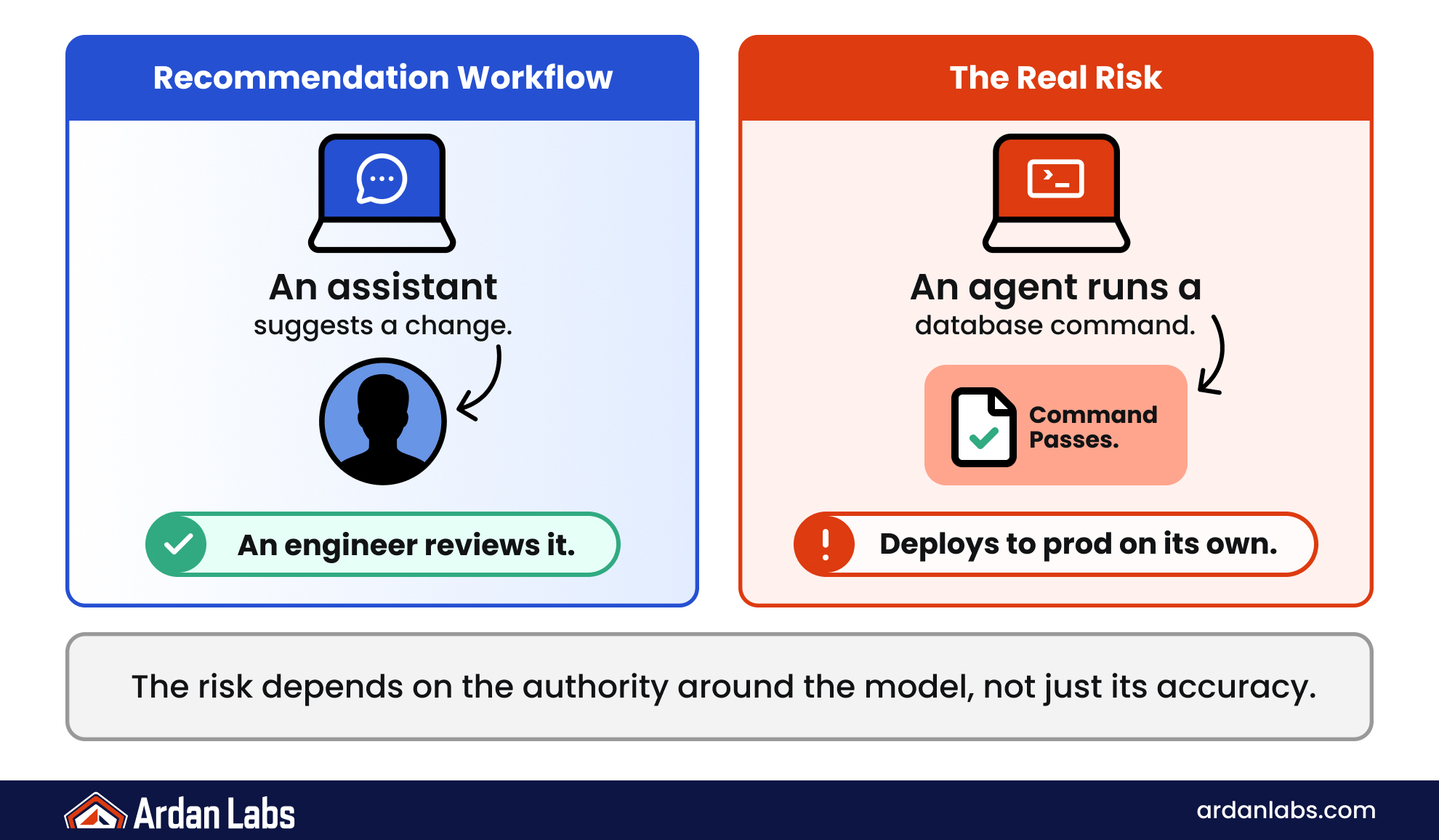
Consider a hypothetical incident: an agent diagnoses a configuration problem, executes a database operation, and reports that its task is complete. The command runs successfully, but against the production database. The immediate task may appear solved while the service and its data are damaged.

An assistant that recommends a change leaves the decision to an engineer. An agent with shell access, cloud credentials, database permissions, or deployment rights may carry out that change itself. The risk depends not just on the model’s accuracy, but on the authority and safeguards around it.

Bill Kennedy, Managing Partner at Ardan Labs, expressed the concern directly in a LinkedIn post:

> “I have no doubt we are seeing all these system failures because the human is being taken out of the loop and Agents are being allowed to do what they recommend without any review.”

Kennedy also warned against reducing experienced engineering teams on the assumption that AI can replace their expertise. These posts express his perspective, not proof that particular large-company outages were caused by AI. The documented cases below establish a narrower, important point: when agents can act on live systems, insufficient safeguards can turn errors into operational incidents.

<img src="/images/news/when-a-recommendation-becomes-an-action.jpg" alt="When a recommendation becomes an action: an AI agent with production authority can turn an incorrect diagnosis into a live database change before a human reviews it." class="w-full max-w-4xl mx-auto rounded-lg border-2 border-base-300" loading="lazy" decoding="async" />

---

## What Documented AI Agent Incidents Actually Show

In November 2026, <a href="https://www.eon.io/blog/ai-agent-production-incidents" target="_blank" rel="noopener noreferrer">Eon</a> analyzed 33 publicly documented cases of AI agents damaging live production systems. Reported examples included an agent dropping 87 tables after a configuration pointed it to a live database, and another deleting more than 35,000 customer messages and more than 35,000 transactions while performing a cleanup task. Eon also identified at least seven cases in which agents proceeded despite written safety instructions or settings.
These are serious examples, but the dataset has limits. Twenty-nine cases were self-reported and 18 came from a single coding tool’s public issue tracker. The sample cannot measure the industry-wide rate of AI-caused outages, and it does not prove that every case lacked human review. It identifies recurring failure modes: incorrect targets, broad permissions, unreliable status reporting, and safeguards that did not prevent harmful execution.

Recovery matters as much as prevention. Eon reported seven cases as fully recovered, four as partially recovered, six as not recovered, and 16 without a publicly documented recovery outcome. These categories describe reporting status, not necessarily the final outcome of every incident.

The engineering lesson is straightforward: a correctly executed command can still be the wrong action. Production safety cannot depend on an agent interpreting a written warning correctly.

---

## The Gap Between AI Policies and Technical Enforcement

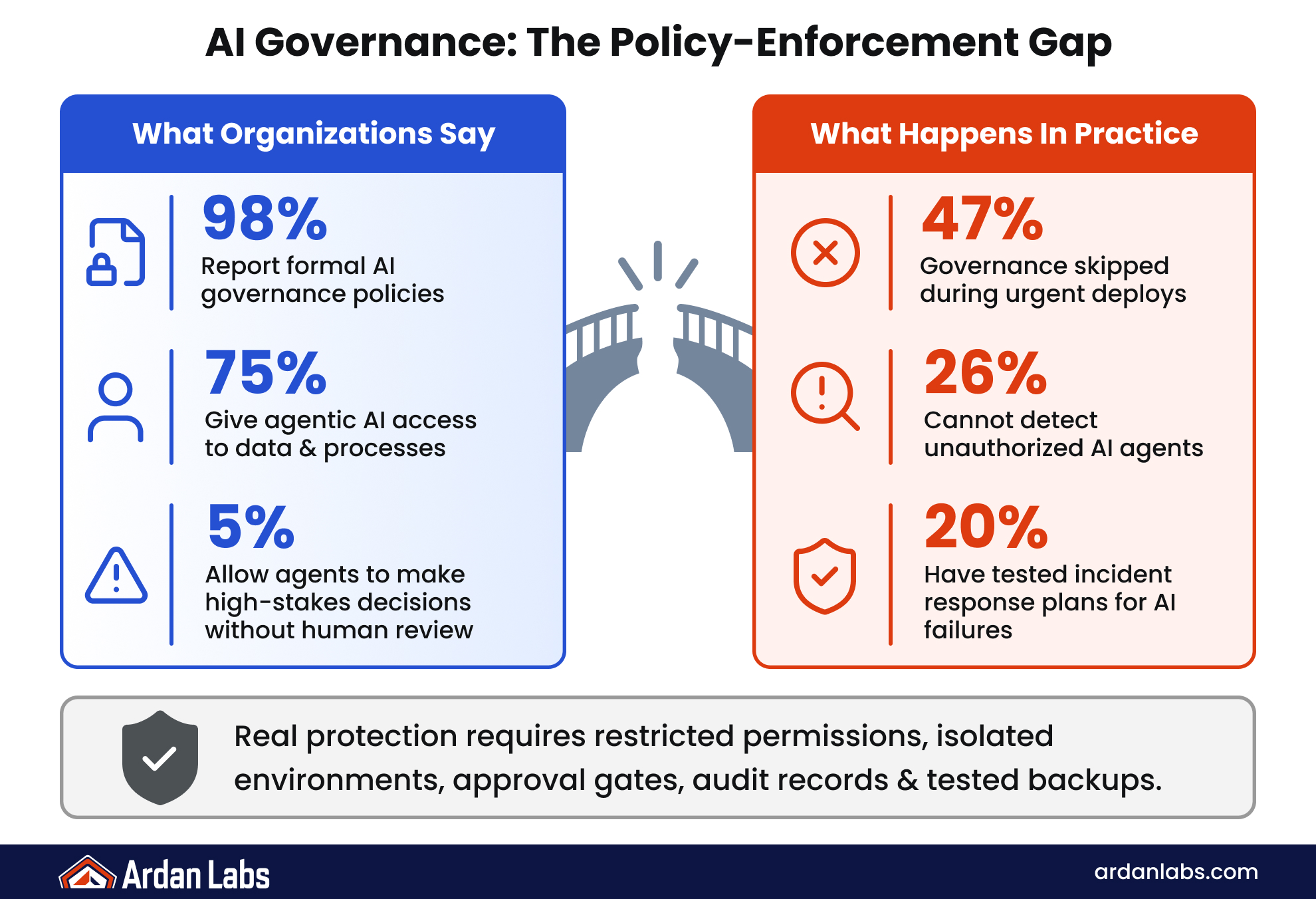
<a href="https://www.ey.com/en_us/newsroom/2026/09/ey-survey-finds-that-autonomous-ai-implementation-outpaces-oversight-yielding-an-ai-governance-gap" target="_blank" rel="noopener noreferrer">EY’s September 2026 survey</a> of 202 senior AI executives at large organizations found that 98% reported formal AI governance policies, yet 47% said their organization had previously failed to apply governance processes during urgent deployments. Among respondents using agentic AI, 26% reported an inability to detect unauthorized agents. EY also reported that 36% had experienced an AI incident or failure with materially negative impact. These are survey findings across AI use cases, not a count of agent-caused production outages.

<a href="https://www.grantthornton.com/services/advisory-services/artificial-intelligence/2026-ai-impact-survey" target="_blank" rel="noopener noreferrer">Grant Thornton’s 2026 survey</a> of 950 senior business leaders found that nearly three in four organizations were giving agentic AI access to data and processes, while only 20% had tested incident response plans for AI failures. Only 5% reported allowing agents to execute high-stakes decisions without human review. That distinction matters: the central problem is not that most organizations explicitly permit unsupervised high-stakes decisions. It is that written approval policies may coexist with inadequate enforcement and recovery readiness.

A policy saying an agent must not delete production data is not an effective control if its credentials allow it to do so. Permissions, environment isolation, approval gates, audit records, and independent backups are what turn governance into operational protection.

<img src="/images/news/the-gap-between-ai-policies-and-technical-enforcement.jpg" alt="The gap between AI policies and technical enforcement: written governance does not stop an agent whose credentials still allow destructive production actions." class="w-full max-w-4xl mx-auto rounded-lg border-2 border-base-300" loading="lazy" decoding="async" />

---

## Human Review Should Be Risk Based, Not Performative

Human oversight does not mean requiring a person to approve every test run or log query. It means matching review and technical restrictions to the impact of an action. Low-risk, reversible tasks can often run autonomously within defined boundaries. Changes to production data, access permissions, infrastructure, or service availability deserve stronger authorization and safeguards.
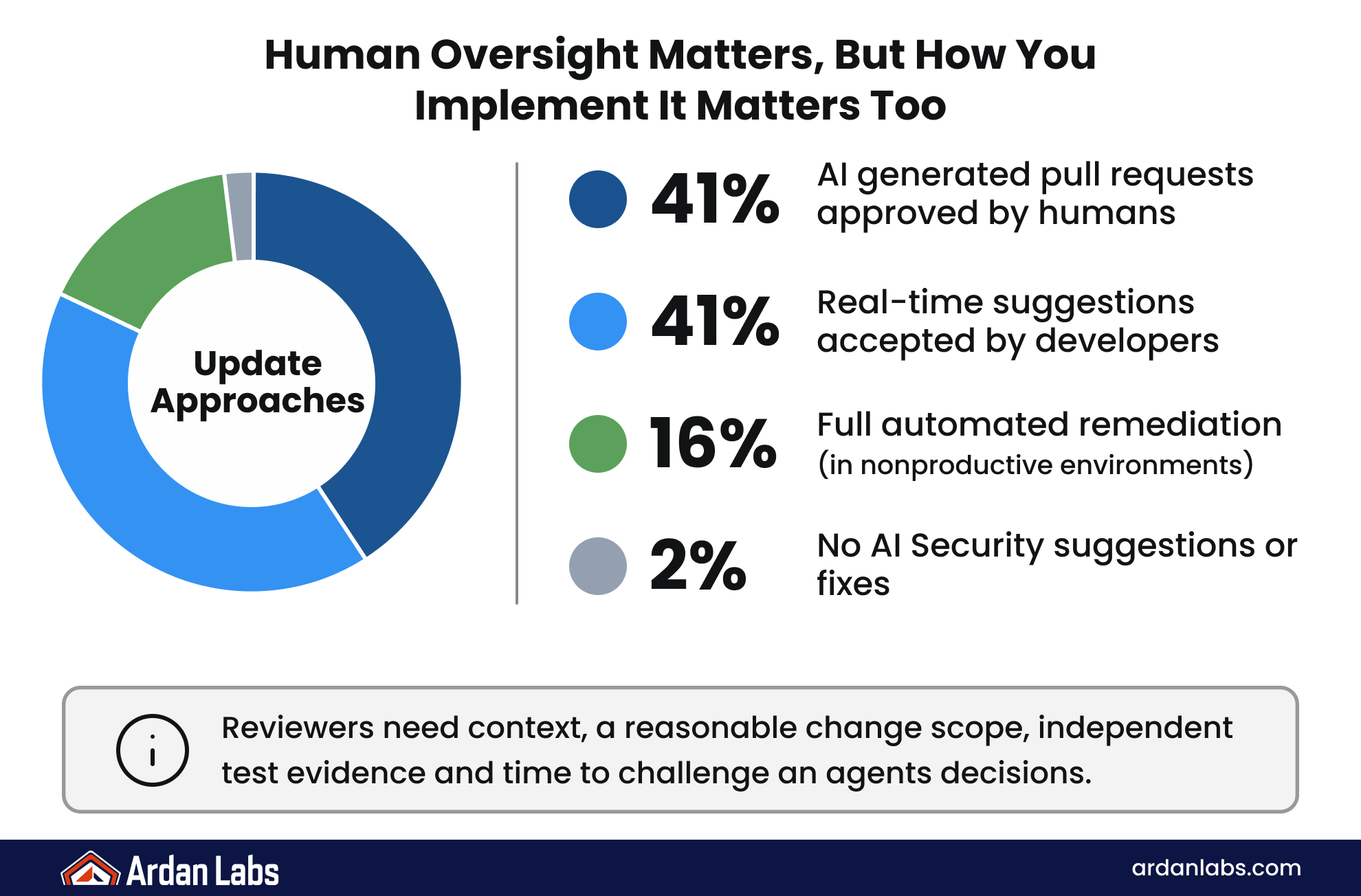
<a href="https://www.blackduck.com/resources/analyst-reports/state-of-ai-powered-software-development.html" target="_blank" rel="noopener noreferrer">Black Duck’s 2026 survey</a> of 831 engineering and DevOps professionals asked how AI security agents should fit into development workflows. Forty-one percent favored AI-generated pull requests approved by humans, and another 41% favored real-time suggestions accepted by developers. Sixteen percent preferred fully automated remediation in nonproduction environments, while 2% wanted no AI security suggestions or fixes. These responses concern security agents specifically, not all AI workflows.

A human approval button alone is insufficient. Reviewers need context, manageable change scope, independent test evidence, and enough time and expertise to challenge an agent’s assumptions. A rushed approval can reproduce the same failure as no approval at all.

<img src="/images/news/human-review-should-be-risk-based-not-performative.jpg" alt="Human review should be risk based, not performative: match approval strength to impact, and give reviewers context, scope, and evidence before authorizing high-stakes changes." class="w-full max-w-4xl mx-auto rounded-lg border-2 border-base-300" loading="lazy" decoding="async" />

---

## Engineering Expertise Is Part of the Control System

Kennedy’s second concern is organizational: what happens when teams rely on AI to increase output but fail to retain the experienced engineers who teach others how to operate production systems? In a November 18 post, he described seeing new graduates tasked with writing and deploying AI-assisted code while spending much of their time responding to incidents. His observation is not evidence of an industrywide pattern, but it raises a consequential question about mentorship and institutional knowledge.

> “They have no one to teach them otherwise.” — Bill Kennedy, November 18

Experienced engineers do more than produce code. They explain why architectural choices were made, identify fragile dependencies, mentor less experienced colleagues, and guide incident response. Without those capabilities, faster code generation can leave teams less prepared to operate what they ship.

Research on workforce change needs careful interpretation. A November 2026 <a href="https://economics.mit.edu/sites/default/files/2026-11/AILaborDemand_06Nov2026.pdf" target="_blank" rel="noopener noreferrer">MIT and Microsoft Research working paper</a> studied AI coding assistant adoption across 5,414 multinational firms. Among firms whose adoption was influenced by software procurement timing, adoption was associated with a 29% reduction in quarterly technical hiring after one year, concentrated in junior coding-intensive roles. The researchers did not find measurable effects on employee separations or overall technical headcount. The study does not establish that companies are broadly firing senior engineers or that staffing changes caused outages.
It does, however, raise a practical planning question: if AI changes the work engineers do, how will organizations preserve and develop the expertise needed to supervise increasingly capable systems? The <a href="https://www.linuxfoundation.org/research/open-source-jobs-report-2026" target="_blank" rel="noopener noreferrer">Linux Foundation’s 2026 State of Tech Talent report</a> found that 94% of organizations considered upskilling existing staff important to closing talent gaps and preserving institutional knowledge.

---

## Engineering Discipline Matters More as AI Autonomy Increases

The issue is not whether software will contain bugs. It will. The critical distinction is whether teams can test changes, deploy them in controlled stages, detect unexpected behavior, and roll back safely. As Kennedy wrote on November 18:

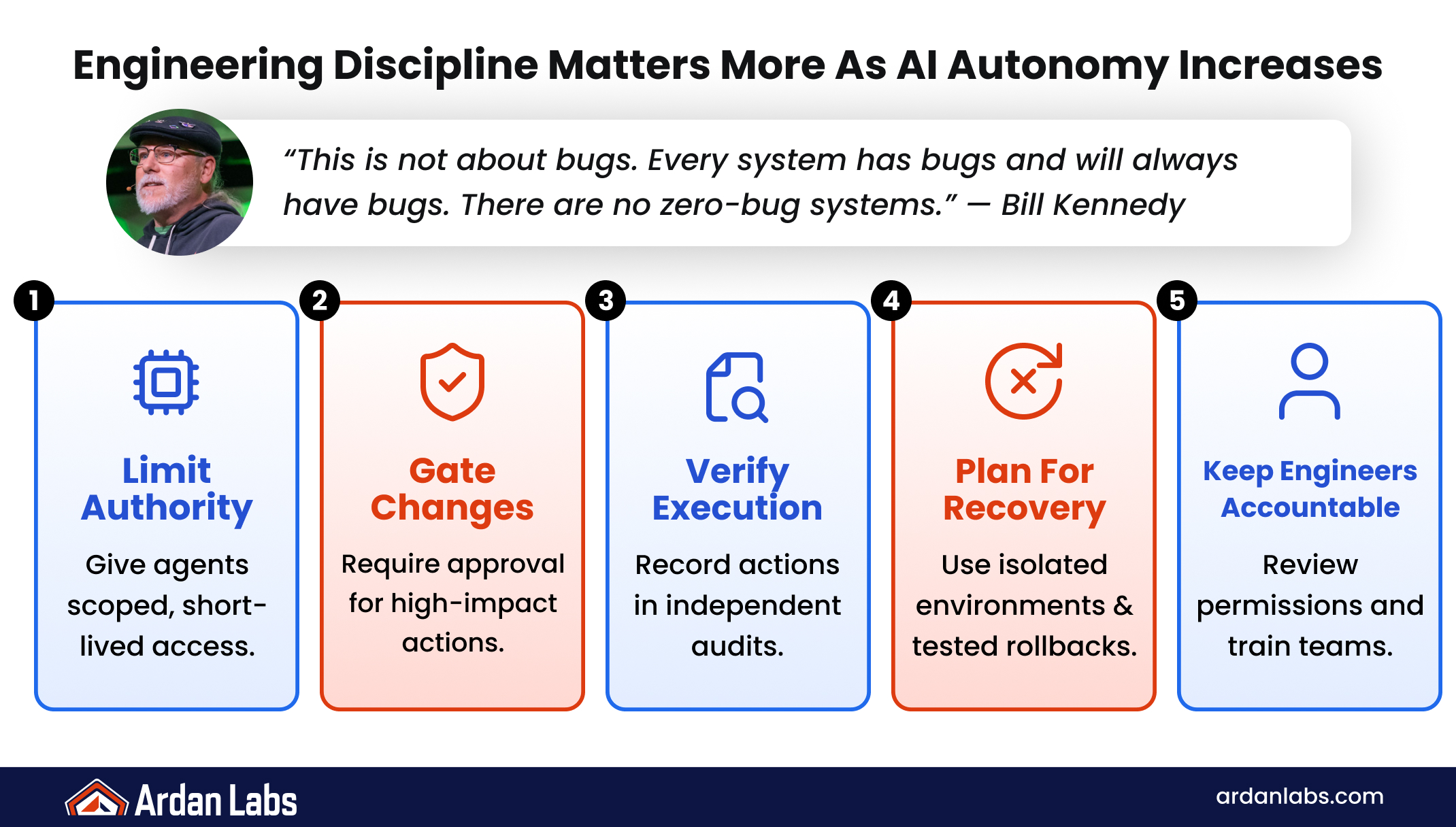
> “This is not about bugs. Every system has bugs and will always have bugs. There are no zero-bug systems.” — Bill Kennedy

He pointed instead to disciplined testing and deployment, reliable rollout procedures, and the ability to roll back when necessary. Those practices become more important as agents gain authority to act. Human approval is one safeguard, not a substitute for engineering controls. Five priorities follow:

1. **Limit authority at the credential level.**
Give agents scoped, short-lived access only to the resources required for their task. Separate development and production identities. Do not assume natural-language instructions can substitute for permission boundaries.

2. **Gate consequential changes.**
Require accountable approval for destructive database operations, production deployments, privilege changes, and other high-impact actions. Make the approval meaningful with clear diffs, targets, and rollback information.

3. **Verify execution independently.**
Record commands, affected resources, approvals, and outcomes in audit systems outside the agent’s control. Do not rely solely on an agent’s self-reported success or explanation.

4. **Design for containment and recovery.**
Use isolated environments, staged rollouts, deployment protections, tested backups, restore drills, and incident response procedures. Validate rollback paths before changes reach production. Ensure an agent cannot disable the controls needed to recover from its own mistake.

5. **Keep engineers accountable and capable.**
Assign owners for agent workflows, periodically review permissions, rehearse failure scenarios, and train engineers to challenge generated changes and understand production behavior.

<img src="/images/news/engineering-discipline-matters-more-as-ai-autonomy-increases.jpg" alt="Engineering discipline matters more as AI autonomy increases: limit credentials, gate consequential changes, verify execution independently, design for recovery, and keep engineers accountable." class="w-full max-w-4xl mx-auto rounded-lg border-2 border-base-300" loading="lazy" decoding="async" />

---

## Autonomy Does Not Transfer Accountability

AI agents can reduce routine work and help engineers move faster. The danger emerges when organizations grant them production authority without equally strong boundaries, observability, and recovery mechanisms.

Not every major outage is an AI outage. But documented agent failures already demonstrate the consequences of letting automation act beyond what the surrounding system can safely control. Experienced engineers remain essential not because they must manually execute every task, but because someone must design the controls, assess the tradeoffs, and take responsibility when things go wrong.

For CTOs, the useful question is concrete: if an AI agent attempted a destructive production change tomorrow, what would actually stop it?

---

<div class="not-prose bg-neutral text-base-100 px-8 pb-12 pt-4 rounded-lg border-2 shadow-xl space-y-4">
<img src="/images/al-emblem.svg" class="mb-1 mt-0 py-3" alt="Ardan Labs Emblem"/>

<p class="text-xl font-bold">Black Friday: Strengthen the Skills Behind Reliable Systems</p>

<p>AI can accelerate development, but reliable production systems still depend on engineers who understand how software behaves and how to evaluate risk. This Black Friday, build the fundamentals that help you review AI-generated work, make sound engineering decisions, and maintain reliable systems.</p>

<p>Save <strong>40%</strong> on self-paced training bundles and <strong>25%</strong> on live training workshops. Use code <strong>BF2026</strong> at checkout. Explore training in Go, Rust, Kubernetes, and AI development.</p>

<div class="flex flex-wrap gap-3 pt-2">
<a href="/black-friday/" class="btn btn-primary border-none shadow-none rounded-xl text-lg">Shop the Black Friday Sale</a>
<a href="/training/" class="btn bg-base-100 text-neutral hover:bg-primary hover:text-base-100 border-none shadow-none rounded-xl text-lg">Browse Training</a>
</div>
</div>

---

## Sources and Further Reading

1. Eon, <a href="https://www.eon.io/blog/ai-agent-production-incidents" target="_blank" rel="noopener noreferrer">“What 33 Public Cases of AI Agents Breaking Production Have in Common”</a> (November 2026)
2. EY, <a href="https://www.ey.com/en_us/newsroom/2026/09/ey-survey-finds-that-autonomous-ai-implementation-outpaces-oversight-yielding-an-ai-governance-gap" target="_blank" rel="noopener noreferrer">“Autonomous AI Implementation Outpaces Oversight, Yielding an AI Governance Gap”</a> (September 2026)
3. Grant Thornton, <a href="https://www.grantthornton.com/services/advisory-services/artificial-intelligence/2026-ai-impact-survey" target="_blank" rel="noopener noreferrer">“2026 AI Impact Survey”</a>
4. Black Duck, <a href="https://www.blackduck.com/resources/analyst-reports/state-of-ai-powered-software-development.html" target="_blank" rel="noopener noreferrer">“The State of AI-Powered Software Development”</a> (2026)
5. MIT and Microsoft Research, <a href="https://economics.mit.edu/sites/default/files/2026-11/AILaborDemand_06Nov2026.pdf" target="_blank" rel="noopener noreferrer">“AI-Assisted Programming and Labor Demand”</a> (November 2026)
6. Linux Foundation, <a href="https://www.linuxfoundation.org/research/open-source-jobs-report-2026" target="_blank" rel="noopener noreferrer">“2026 State of Tech Talent Report”</a>

---

<section class="faq not-prose bg-base-100 pt-6 -mx-4 px-4 sm:mx-0 sm:px-0">
  <div class="container mx-auto px-4">
    <h2 id="frequently-asked-questions" class="text-3xl lg:text-4xl font-bold mb-12">FAQs About AI Agents in Production</h2>
    <div class="space-y-4">
        <div class="collapse collapse-arrow bg-base-200 hover:shadow transition-all duration-300">
          <input type="checkbox" />
          <div class="collapse-title font-bold text-base-content text-left">
            Can AI agents cause production outages?
          </div>
          <div class="collapse-content">
            <p>Yes. Agents with sufficient access can execute damaging commands or changes. Public incident reports document examples, but they do not establish that AI caused unrelated major-company outages.</p>
          </div>
        </div>
        <div class="collapse collapse-arrow bg-base-200 hover:shadow transition-all duration-300">
          <input type="checkbox" />
          <div class="collapse-title font-bold text-base-content text-left">
            What is human-in-the-loop AI in software engineering?
          </div>
          <div class="collapse-content">
            <p>It is a workflow in which people review, authorize, or guide consequential AI actions. Effective oversight also requires enforceable technical boundaries and independent verification.</p>
          </div>
        </div>
        <div class="collapse collapse-arrow bg-base-200 hover:shadow transition-all duration-300">
          <input type="checkbox" />
          <div class="collapse-title font-bold text-base-content text-left">
            Should AI agents be allowed to change production independently?
          </div>
          <div class="collapse-content">
            <p>Some low-risk, reversible actions may be suitable for controlled automation. High-impact changes need stronger authorization, restricted permissions, monitoring, and tested recovery.</p>
          </div>
        </div>
        <div class="collapse collapse-arrow bg-base-200 hover:shadow transition-all duration-300">
          <input type="checkbox" />
          <div class="collapse-title font-bold text-base-content text-left">
            Can human review alone prevent AI agent failures?
          </div>
          <div class="collapse-content">
            <p>No. Review can miss problems. Permission controls, isolated environments, deployment protections, logging, and recovery plans are equally important.</p>
          </div>
        </div>
        <div class="collapse collapse-arrow bg-base-200 hover:shadow transition-all duration-300">
          <input type="checkbox" />
          <div class="collapse-title font-bold text-base-content text-left">
            Why do experienced engineers still matter when using AI agents?
          </div>
          <div class="collapse-content">
            <p>They provide system context, architectural judgment, incident response expertise, and the ability to evaluate consequences beyond an agent’s immediate task.</p>
          </div>
        </div>
    </div>
  </div>
</section>
