AI has moved well beyond experimentation in software development. Coding assistants, AI agents, and general-purpose AI tools are now part of how many engineers write code, troubleshoot problems, and navigate unfamiliar systems.
But widespread adoption doesn’t necessarily mean unconditional trust.
According to Stack Overflow’s 2026 Developer Survey, 83% of respondents use at least one AI tool in their work. At the same time, only 6.6% say they trust AI output for many tasks, including important work decisions.
It’s an interesting contrast. Developers are incorporating AI into their daily workflows while remaining selective about when and how they rely on its output. The immediate interpretation might be that AI has a trust problem. But looking beyond those two statistics reveals a more nuanced picture.
Developers are finding value in AI, developing preferences around where it works best, and establishing their own expectations for what makes its output useful. For engineering organizations, these findings offer a look at how AI adoption is evolving and what teams may need as the technology becomes a more permanent part of software development.
AI Adoption Is No Longer Just Experimentation
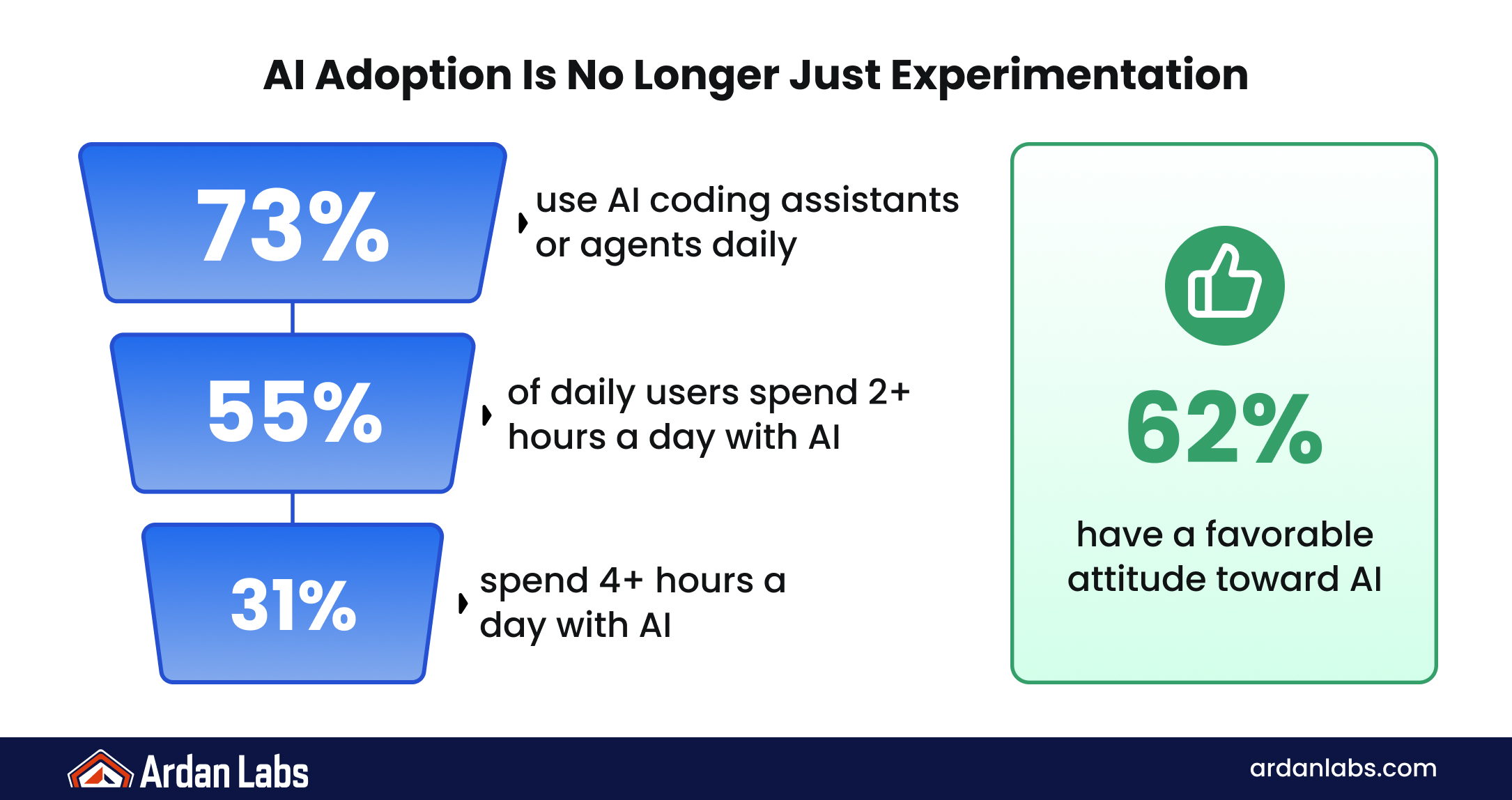
The survey’s adoption figures show how thoroughly AI has entered the development workflow. Of respondents who use AI coding assistants or agents, 73% use them daily. Among daily AI users, 55% spend at least two hours of their workday using AI tools, including 31% who spend four hours or more.
That’s a meaningful amount of time spent working alongside technology that was still relatively new to many development teams just a few years ago.
And the adoption extends beyond code generation. Developers are using AI to debug existing applications, understand unfamiliar codebases, improve tests, answer technical questions, and explore architectural decisions. These are activities that touch nearly every stage of software development.
The survey also found that 62% of respondents have a favorable attitude toward using AI tools or agents at work. That matters because the conversation around AI adoption often focuses on the tension between excitement and skepticism. The data suggests that developers can recognize the practical value of AI while maintaining reservations about certain applications.
An engineer might rely on AI every day to investigate errors, generate test cases, or explore unfamiliar libraries without necessarily trusting it to make an architectural decision independently.
Those positions aren’t contradictory. They reflect different expectations for different tasks.
As AI becomes more familiar, the conversation is moving beyond whether developers use it and toward understanding how they use it effectively.
Developers Are Finding Value in Specific AI Workflows
One of the more useful aspects of the 2026 survey is that it looks beyond general AI adoption and examines the tasks developers are using it for. The differences are revealing.
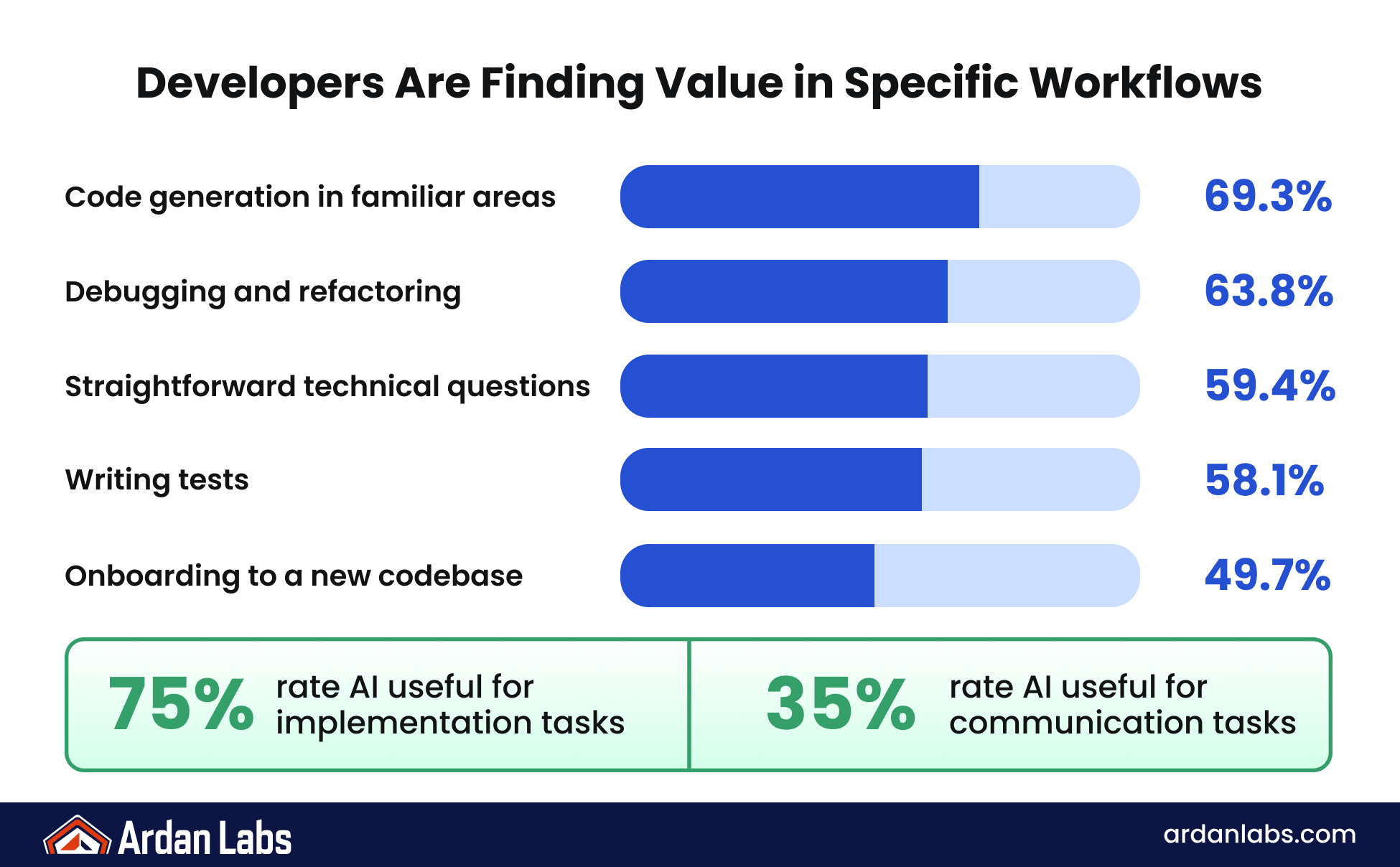
According to the survey, developers currently use AI for:
- 69.3%: Generating code in familiar areas
- 63.8%: Debugging, troubleshooting, or refactoring
- 59.4%: Answering straightforward technical questions
- 58.1%: Writing or improving tests
- 49.7%: Understanding or onboarding to a new codebase
These results suggest that AI has found a practical role across activities developers encounter regularly.
The survey’s usefulness ratings reinforce that observation. Approximately 75% of respondents rated AI as useful or very useful for implementation, while 73% said the same for debugging and refactoring. But the experience isn’t uniform across every task.
Only 35% rated AI as useful or very useful for communication tasks, and 46% said they don’t use AI for communication and don’t plan to. That difference is worth examining.
Some development tasks have clear feedback mechanisms. Code can be compiled, tests can be executed, and behavior can be compared against known requirements. Other activities involve more subjective decisions, organizational context, or communication preferences.
It’s reasonable that developers would evaluate AI differently across these situations. This also suggests that the next stage of adoption may be less about finding ways to insert AI into every activity and more about understanding where it provides meaningful value.
For engineering leaders, that’s a useful distinction. A tool that improves one part of the development process may not be equally effective across the entire workflow.
The objective should be to identify where AI contributes to better engineering outcomes, rather than treating usage itself as the outcome.
Trust Is Conditional, and That Isn’t Necessarily a Bad Thing
Perhaps the most discussed finding from the survey is the gap between AI adoption and trust.
Only 6.6% of respondents say they trust AI for many tasks, including important work decisions. However, that statistic tells only part of the story.
Another 48% say they trust AI when they can easily verify its output. An additional 16.3% trust it for many tasks but not important work decisions, while another 16.3% limit their trust to low risk work.
In other words, developers aren’t simply dividing into two groups of people who trust AI and people who don’t. Many are making distinctions based on the nature of the task and their ability to evaluate the result. That is a different story from widespread rejection of AI.
Consider how an engineer might use an AI assistant to troubleshoot an unfamiliar error. The assistant can suggest possible causes, explain relevant concepts, and recommend approaches to investigate. The engineer can then compare those suggestions against logs, documentation, tests, and the actual behavior of the application. The AI doesn’t need to be treated as an unquestionable authority to be useful. Its value comes from helping the engineer investigate the problem more effectively.
Now consider a different situation: an AI agent recommending a significant change to the architecture of a production system. The consequences of that recommendation are potentially much greater, and evaluating it may require knowledge of performance requirements, operational constraints, security considerations, and long-term maintenance.
It makes sense that an engineer would apply a different level of scrutiny.
The survey doesn’t establish that every developer makes these distinctions for the same reasons. But it does demonstrate that trust varies according to how AI is being used.
The more interesting question may not be how much developers trust AI overall, but what conditions make them comfortable relying on it.
Verification Is Already Part of the AI Development Workflow
The survey provides another important clue about how developers are adapting to AI. When asked what they typically do before using an AI-generated answer for a development task, respondents described several forms of validation.
76.5% run the output locally. Another 63.9% compare it against their existing codebase, while 53% inspect testing or security implications.
Only 9.6% say they use the generated answer as-is.
These findings show that many developers are already treating AI output as something to evaluate rather than automatically accept. And that’s a meaningful distinction.
Software engineers have always worked with code and information produced by others. Open source libraries, documentation, technical forums, and contributions from teammates all become part of the development process. AI introduces a new way to generate that information, often at considerably greater speed.
The methods used to evaluate it, however, remain familiar: testing behavior, reviewing implementation details, consulting documentation, and checking whether a proposed solution fits the existing system.
The survey doesn’t tell us whether these practices are always sufficient, or whether every team applies them consistently. It does show that validation is a common part of how respondents work with AI.
For CTOs and engineering managers, this raises a practical consideration.
As AI-assisted development becomes more common, organizations need to understand not only which tools their engineers use, but how those tools fit into existing review, testing, and delivery processes.
A team may already have effective practices in place. Another may be relying on individual developers to establish their own methods. Understanding those differences can help leaders identify where clearer standards, shared knowledge, or additional tooling would be useful.
Experienced Developers Are Among AI’s More Favorable Users
Another interesting result challenges a common assumption about who is most enthusiastic about AI. Among respondents with 16 or more years of professional experience, 69% reported a favorable attitude toward AI tools. Among respondents with one to five years of experience, that figure was 53%.
The survey doesn’t explain why this difference exists, and it would be premature to conclude that experience itself causes greater enthusiasm. Still, the finding is noteworthy.
It’s easy to assume that engineers who have spent years developing software without AI would be less inclined to embrace it. The results suggest that isn’t necessarily the case.
One possible explanation is that experienced engineers have a broader understanding of the development activities where AI can provide value. They may recognize opportunities to accelerate familiar tasks or reduce repetitive work while remaining comfortable evaluating the results.
But that’s an interpretation, not a conclusion established by the survey.
What the data does demonstrate is that favorable attitudes toward AI are not limited to developers at the beginning of their careers.
For organizations introducing AI into established engineering teams, this is an encouraging finding. It suggests that experience and openness to AI can coexist, and that organizations shouldn’t assume their most experienced engineers will be the least interested in adopting new tools.
It also raises an opportunity for teams to share practical knowledge across experience levels, particularly around which AI workflows have proven useful and how developers incorporate them into their work.
Developers Are Still Evaluating Which AI Tools Deserve a Place in Their Workflow
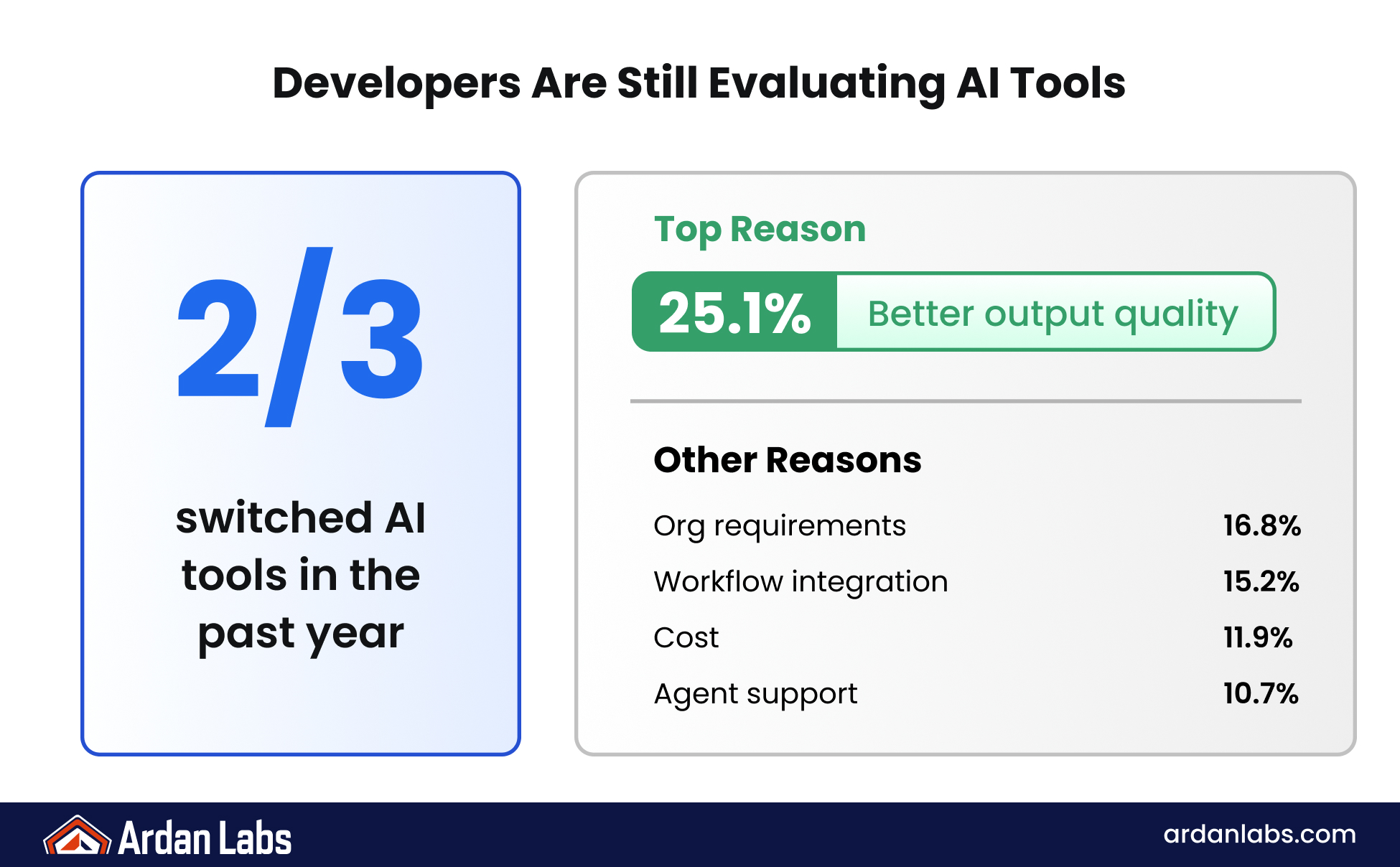
Adoption doesn’t necessarily mean developers have settled on the tools they intend to use long term. The survey found that approximately two-thirds of respondents had switched AI tools for work during the previous year. The most frequently selected reason was better output quality, cited by 25.1% of all respondents to the question.
Other reasons included organizational requirements, better workflow integration, lower cost, and improved support for agents or automation. That suggests developers are still actively comparing what different tools offer. This is particularly interesting given how frequently AI is already being used. The technology may have become part of everyday development, but the tools themselves are still competing for a lasting place in that workflow.
For an engineer, switching tools may reflect a desire for more useful answers, better integration with an existing development environment, or functionality that better supports a particular project.
For organizations, the implications extend beyond selecting a popular AI product.
Tool decisions can affect development practices, security requirements, data access, operational costs, and how consistently teams work across projects. A tool that performs well in an isolated demonstration may not necessarily be the right fit for an organization’s production environment.
This is where a more deliberate approach to AI adoption becomes valuable. Rather than assuming one tool should solve every problem, engineering teams can evaluate AI capabilities against their actual requirements and determine where different approaches make sense. That may include coding assistants for individual developers, AI agents for specific workflows, or AI systems integrated directly into internal applications.
The important consideration is whether the technology supports the work the organization needs to accomplish.
What the Survey Means for Engineering Leaders
Taken together, the findings suggest that AI adoption is entering a more established phase.
Developers are using the tools regularly, identifying where they provide value, validating their output, and comparing alternatives based on their needs.
For CTOs and engineering managers, the next challenge may be less about encouraging initial adoption and more about helping teams use AI effectively and consistently.
That starts with understanding how AI is already being used within the organization:
- Which development activities are benefiting most?
- Where do engineers encounter limitations?
- What validation practices are in place?
- Are teams using tools that fit their technical environments and security requirements?
These questions provide more actionable information than an adoption percentage alone. They can also help organizations determine where additional investment makes sense.
For some teams, the priority may be AI training, helping engineers become more proficient with the tools they’re already using and better understand how AI systems work.
For others, it may be AI Engineering and Implementation, integrating AI capabilities into existing applications with the architecture, security, and operational controls required for production.
Organizations expanding their development capacity may also benefit from AI-ready engineers who are comfortable working with modern development tools while bringing the production experience needed to contribute to established systems.
At Ardan Labs, these areas connect directly to how we help engineering organizations evolve.
Our AI Implementation Services focus on building AI capabilities into real software systems, while our Staff Augmentation Services provide experienced engineers who can integrate into existing teams and contribute within modern development environments.
Through our technical training programs, including Ultimate AI and Practical Go Development with AI Agents, we also help engineers build a deeper understanding of AI technologies and how to apply them effectively.
The common thread is that AI adoption should support an organization’s engineering goals, rather than become a goal of its own.
Final Thoughts: From AI Adoption to AI Maturity
The 2026 Stack Overflow Developer Survey tells a more interesting story than simply showing that AI usage is increasing while trust remains limited. It shows developers incorporating AI into their work, identifying where it performs well, establishing expectations around verification, and continuing to evaluate the tools available to them.
The findings don’t suggest that AI has become universally trusted, nor do they indicate that developers are turning away from it. Instead, they reveal a development community that is becoming more familiar with AI’s capabilities and more selective about how those capabilities are applied. That distinction matters.
As AI becomes a standard part of software development, success will increasingly depend on understanding where it creates value, how it fits into established engineering practices, and what organizations need to support its effective use.
For developers, that means continuing to explore the technology while building the skills needed to work with it confidently.
For engineering leaders, it means looking beyond adoption metrics and paying closer attention to how AI affects the way their teams build, evaluate, and deliver software.
The next stage of AI adoption isn’t simply about using more AI. It’s about getting better at using the AI we already have.

At Ardan Labs, we help organizations navigate that transition through practical AI training, experienced engineering talent, and production focused AI implementation.
Let's talk about how we can help your team put AI to work.
Sources
Primary survey data
- Stack Overflow, “The Results of the 2026 Developer Survey Are Here!"
- Stack Overflow, “2026 Developer Survey, AI Data”
- Stack Overflow, “Getting Ready for 2026 Results, A Look Back on Developer Survey Findings”
Ardan Labs
Frequently Asked Questions
The survey found that 83% of respondents use at least one AI tool at work, with 73% of AI coding assistant or agent users reporting daily usage. These findings indicate that AI has become a regular part of many software development workflows.
The survey found that 48% of respondents trust AI when they can easily verify its output, while only 6.6% trust it for many tasks including important work decisions. This suggests that many developers distinguish between using AI as a helpful tool and relying on it for decisions with greater consequences.
Respondents rated AI particularly useful for implementation, debugging, refactoring, documentation, and code review. AI's perceived usefulness varies by activity, indicating that its value depends partly on the type of work being performed.
In the 2026 survey, 69% of respondents with 16 or more years of experience reported favorable attitudes toward AI, compared with 53% of respondents with one to five years of experience. The survey establishes an association between experience and sentiment, but not the reason for the difference.
Engineering leaders should understand where AI is providing value, how developers verify its output, which tools fit their workflows, and where additional training or implementation support may be beneficial. Effective adoption involves more than measuring how frequently employees use AI.