
The Question Has Already Changed
A year ago, the question around AI agents in engineering teams was simple: can they actually do the work?
That question has largely been answered.
Modern AI agents can generate code, interact with APIs, navigate repositories, and execute multi step workflows that previously required significant human effort.
The harder question has quietly replaced it: not what can they do, but what can we safely trust in production?
Because once these systems move out of demos and into real environments, something changes. They stop behaving like predictable tools, and start behaving like systems operating under uncertainty.
That is where most of the engineering conversation is now centered.
The Demo Works Until the System Gets Real
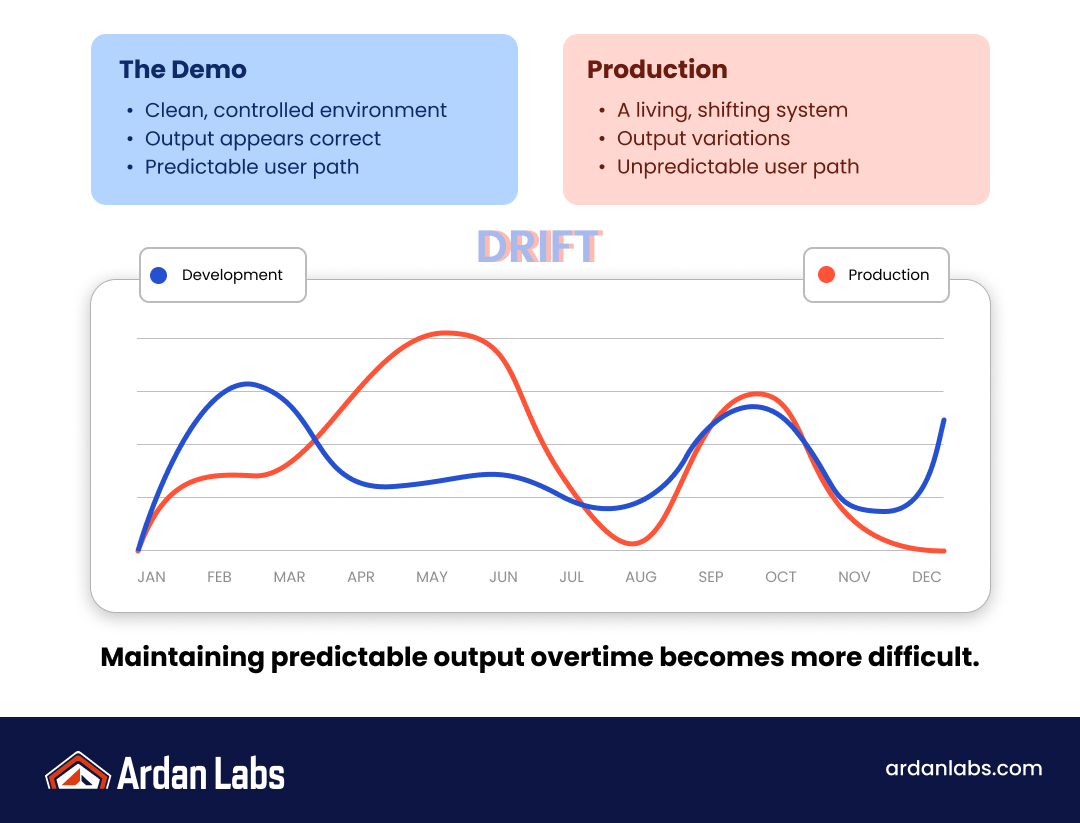
A familiar pattern has emerged across engineering teams adopting AI agents. In controlled environments, everything looks clean. Agents plan tasks, call tools, recover from minor errors, and produce outputs that appear correct and complete.
The experience feels almost seamless.
But production systems are not controlled environments. They are living systems with changing dependencies, shifting state, and incomplete context that evolves over time.
Once agents are introduced into that environment, subtle problems begin to appear.
Not catastrophic failures. Drift.
Long-running workflows lose alignment with original intent. Tool responses vary in ways the agent does not fully account for. External systems evolve independently. Context expands beyond what was available when earlier decisions were made.
Individually, each step still looks reasonable. But collectively, the system starts producing outcomes that are no longer fully grounded in reality.
The issue is not whether the agent can produce output. It is whether that output remains correct across time, state changes, and system boundaries.
Why This Problem Is Not Just About Model Quality
One important finding from recent research is that production reliability is not purely a model-capability issue.
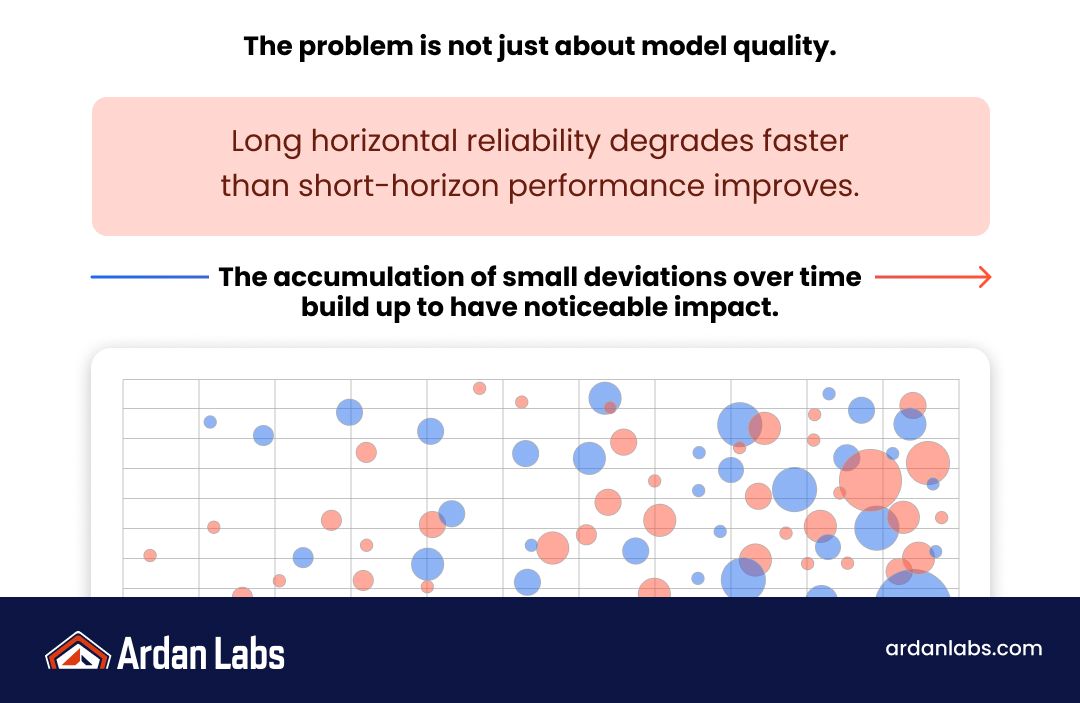
METR’s work on time-horizon performance shows a consistent pattern: even as models improve, long-horizon task reliability degrades faster than short-horizon performance improves. Models can get better at individual steps while still struggling with sustained multi-step coherence in real environments.
That aligns with what many engineers observe in practice. The failure point is rarely a single incorrect step. It is the accumulation of small deviations across a chain of decisions that were individually reasonable.
Benchmarks tend to evaluate isolated correctness. Production systems evaluate sustained correctness under changing conditions. Those are not the same problem.
The Bottleneck Is Verification, Not Generation
Software engineering has always been constrained more by verification than creation.
Every major discipline in production systems exists to reduce uncertainty:
- Unit tests validate behavior at the function level.
- Integration tests validate interactions between components.
- CI pipelines validate changes before they reach production.
- Observability systems validate behavior after deployment.
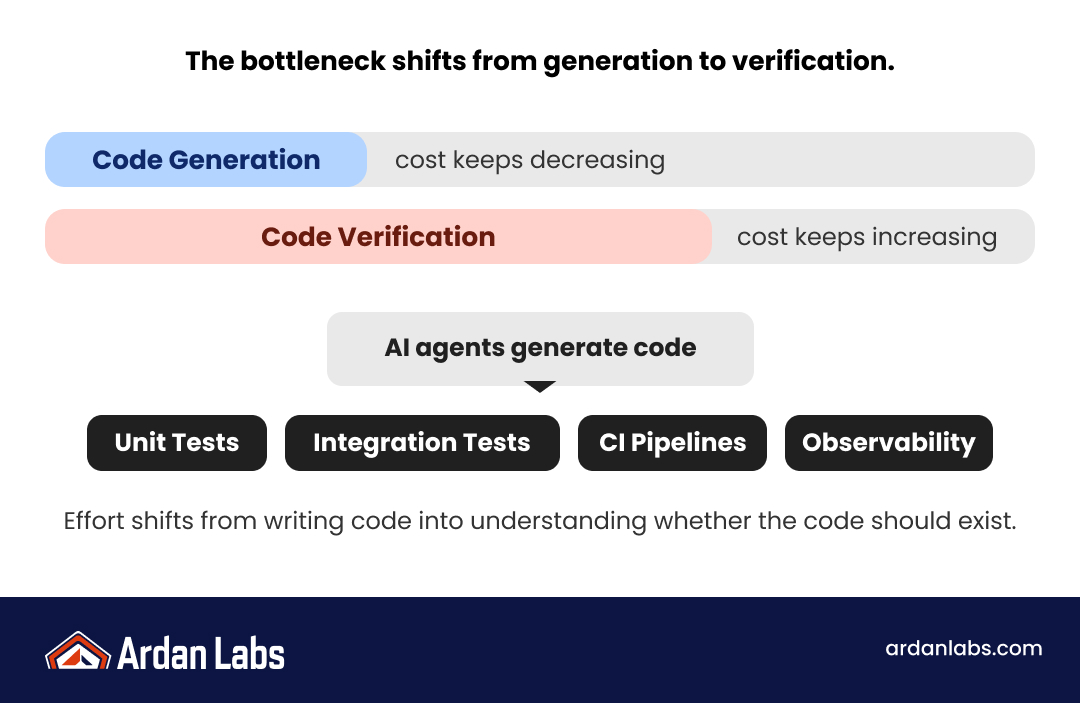
AI agents disrupt this balance by dramatically lowering the cost of generation while leaving verification largely unchanged.
And verification is not a simple yes or no check. It requires understanding system behavior across multiple dimensions at once: architecture, performance, security, concurrency, and long-term maintainability.
This is where friction appears.
Even when AI-generated output is correct in isolation, validating its correctness in context still requires human reasoning. That means the bottleneck shifts downstream.
Not into writing code. But into understanding whether the code should exist in the first place.
A practitioner observation that captures this shift well is:
The tool is not the system. The workflow is the system.
Once teams internalize this, the focus moves away from generation speed and toward confidence in system behavior.
Why Autonomy Shrinks in Production
One of the most consistent patterns in real deployments is that autonomy decreases as experience increases.
At first, teams experiment with broad agent responsibilities. A single agent might attempt to handle an entire workflow end to end. This often works in demos or constrained environments.
But production usage reveals a different reality.
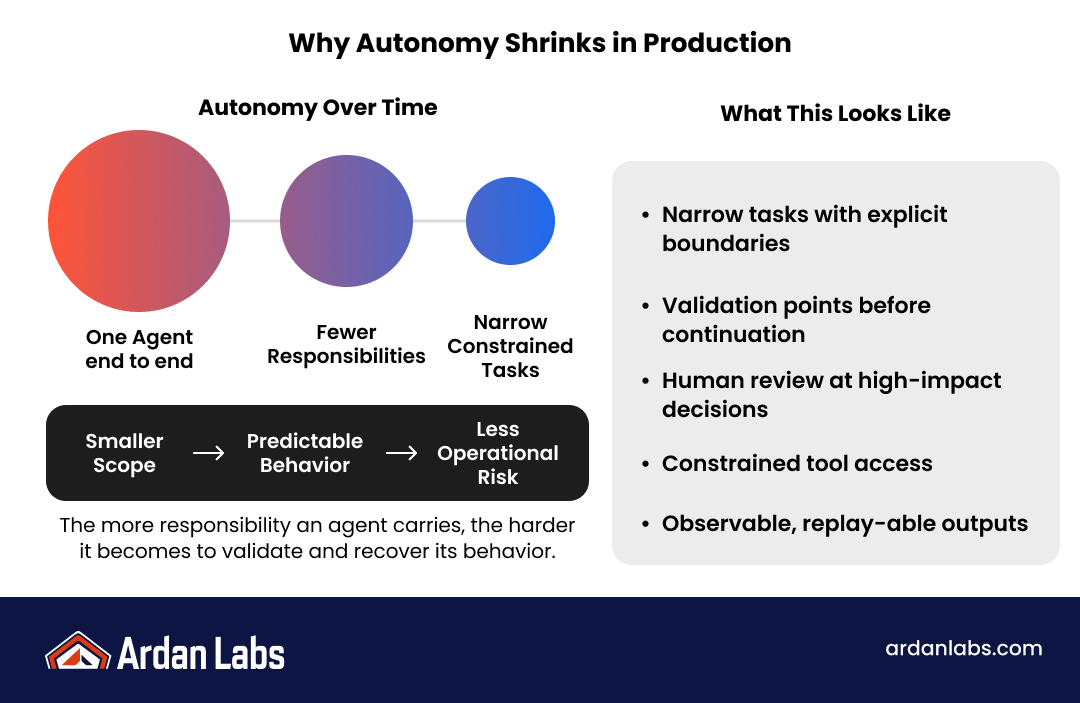
The more responsibility an agent carries, the harder it becomes to understand, validate, and recover its behavior when something goes wrong.
Over time, systems evolve in the opposite direction of initial expectations. Instead of one autonomous system, teams build smaller, more constrained components with clearly defined responsibilities.
This often looks like:
- Agents that operate on narrow tasks with explicit boundaries.
- Steps that include validation points before continuation.
- Human review at decision points with system impact.
- Constrained tool access rather than broad permissions.
- Observable intermediate outputs that can be inspected and replayed.
These changes are not ideological. They are operational.
Smaller scope produces more predictable behavior. Predictable behavior reduces operational risk. And in production systems, that tradeoff dominates design decisions.
From AI Problem to Systems Problem
As AI agents move deeper into production environments, something important happens. The problem stops looking like an AI problem. It starts looking like a distributed systems problem.
Engineers shift their attention away from prompting techniques and toward operational concerns that are already familiar from large scale system design.
Questions become less about reasoning ability and more about system behavior:
- How do we handle partial failures in tool execution?
- How do we ensure operations are idempotent?
- How do we recover from inconsistent intermediate states?
- How do we trace decisions across multiple steps and services?
- How do we manage permissions safely across tool boundaries?
These are not new categories of problems. They are classic distributed systems concerns. The only difference is that now one of the components is probabilistic.
Once that shift happens, familiar engineering constraints begin to dominate system design again.
Observability Becomes the Foundation of Trust
Traditional software systems rely on logs, metrics, and traces to reconstruct behavior after execution.
AI agent systems require something more nuanced because execution paths are not strictly linear.
Understanding what happened often requires visibility into intermediate reasoning, tool usage, context transitions, and decision branching. Without that visibility, debugging becomes speculation instead of analysis.
This is why observability becomes central to production adoption of AI systems.
Google’s DORA research consistently reinforces that high performing teams invest heavily in observability and fast feedback loops because they reduce uncertainty in system behavior.
That principle becomes even more important when systems include probabilistic components, where identical inputs may not always produce identical execution paths.
What Research and Practice Agree On
Research into AI systems aligns closely with what engineering teams are experiencing in production.
METR’s research on time horizon performance shows that long-running task reliability remains a core challenge, even as models improve in isolated capabilities.
The key insight is that improving step level performance does not guarantee reliability across extended workflows where context, state, and external dependencies change over time.
Similarly, Anthropic’s work on agent design emphasizes that simpler, composable systems consistently outperform fully autonomous architectures in production environments.
The pattern is consistent across both research and practice.
Reliability improves when systems are decomposed, constrained, and observable. Not when they are made more autonomous.
Where AI Agents Actually Work Today
Despite limitations, AI agents are already delivering meaningful value in production environments.
The difference is not capability. It is scope.
One related source of failed adoption is labeling. Many tools marketed as “agents” are closer to scripted workflows with an LLM step. That mismatch between expectations and architecture often fails teams before capability is even tested.
Successful use cases are narrow, repetitive, and easy to validate. They exist inside well-defined boundaries where outputs can be quickly reviewed and corrected if necessary.
This includes work such as:
- Documentation generation that follows established formats and patterns.
- Test generation for known systems with predictable behavior.
- Pull request summarization and change explanation.
- Migration support for repetitive code transformations.
- Boilerplate scaffolding inside established architectures.
- Structured data extraction from logs or repositories.
What makes these workflows successful is not autonomy, but constraint.
Agents operate effectively when they function as accelerators inside structured systems rather than independent decision makers.
A model that consistently emerges in engineering teams is simple but accurate:
Treat agents as highly capable junior engineers.
They are fast, helpful, and productive within clear boundaries. But they still require context, validation, and oversight for anything that impacts system correctness.
Engineering Judgment Becomes the Constraint
As AI systems increase the volume of generated output, the limiting factor in engineering shifts.
It is no longer how fast software can be produced. It is how effectively that software can be evaluated.
This is where engineering judgment becomes the defining constraint.
AI systems can generate multiple plausible implementations for the same problem. What they cannot reliably do is evaluate long-term consequences such as architectural consistency, operational complexity, or failure behavior under real production load.
These are not pattern matching problems. They are experience based reasoning problems. This is why senior engineers remain central in AI-assisted workflows. Not because they produce more output. But because they determine what output is acceptable in a real system.
Governance Is System Design
Many organizations reach for governance as a solution to agent risk. But governance in agentic systems is often misunderstood as documentation, approval flows, or policy.
In reality, governance is an architectural concern. It determines whether a system can answer fundamental operational questions:
- What did the agent actually do?
- Why did it take a specific action?
- Can we reproduce the exact sequence of decisions?
- How do we safely roll it back if needed?
If a system cannot answer these questions, it is not governed in a meaningful sense regardless of process documentation. Governance in AI systems is inseparable from observability and system design. You cannot govern what you cannot observe.
What Strong Production Systems Look Like
Across organizations successfully deploying AI agents, production architectures converge on a consistent structure.
These systems prioritize control over autonomy.
They typically include:
- Narrow and well-defined agent responsibilities.
- Explicit input and output contracts.
- Human review for non-trivial changes.
- Strong observability across all steps.
- Clear rollback and recovery mechanisms.
- Constrained permissions and tool access.
What makes these systems effective is not their complexity, but their clarity. They are designed to remain understandable under failure conditions.
And that is what makes them operable at scale.
When Systems Appear Correct but Are Not
Traditional software systems tend to fail loudly. A crash, an exception, or a broken deployment makes it immediately clear that something is wrong.
Agentic systems often fail differently. They produce outputs that appear correct. Code compiles. APIs return responses. Workflows complete successfully. On the surface, everything looks operational.
But the system behavior is quietly misaligned with intent. Correctness that is only superficial does not break execution it breaks expectations. And it is much harder to detect.
Engineers who have worked with these systems often describe the same experience:
The system didn’t break. It just started making decisions we couldn’t fully explain.
This is why observability, verification, and traceability are not optional enhancements. They are foundational requirements for production systems that include AI agents.
The Real Shift in Engineering Work
AI agents do not remove engineering work. They reshape it.
They increase the speed of generation, but also increase the importance of validation, system design, and engineering judgment.
Organizations that succeed with these systems are not those maximizing autonomy. They are those designing systems where autonomy is carefully bounded, observable, and controllable.
AI changes how software is written. It does not change what makes software reliable. That still depends on architecture, discipline, and experienced engineers who understand how systems behave under real conditions.

Build AI-Assisted Systems Without Losing Production Discipline
At Ardan Labs, we help teams adopt AI-assisted engineering without sacrificing reliability or system integrity.
Our engineers bring deep experience in distributed systems, cloud architecture, and production operations. We focus on building systems that remain observable, maintainable, and safe under real-world constraints.
Through Consulting, Staff Augmentation, and AI Implementation services, we help organizations integrate AI agents into workflows that enhance engineering capacity without compromising production stability.
Because the challenge is not generating more software. It is building software that can be trusted to run in production.
Frequently Asked Questions
Yes, but only in tightly scoped workflows with strong observability, validation, and human oversight. Fully autonomous systems remain rare in stable production environments.
Demos operate under controlled assumptions. Production systems introduce changing state, external dependencies, and long-running workflows that expose drift and compounding errors.
Silent failure. Systems may produce plausible outputs that are subtly incorrect without obvious signs of malfunction.
In narrow, repetitive, and verifiable tasks such as documentation, testing, scaffolding, and internal tooling.
Observability, governance, system boundaries, verification processes, and engineering judgment.
No. It increases their importance by shifting effort from generation to evaluation, architecture, and system design.