
This article explains why generic rankings miss the point, how to think about staff augmentation differently, and what actually matters when you're evaluating partners for your team.
How to Evaluate Staff Augmentation Partners Beyond Rankings
The staff augmentation market ranks companies by headcount, revenue, and global delivery capacity. Search for top staff augmentation companies and if you scan these rankings, you’ll find similar names repeated across similar criteria. They give the impression that the market has already been sorted for you.
But these lists are answering the wrong question.
They assume that staff augmentation is a commodity market, that bigger is better, that speed to placement is the only variable that matters, and that vendor selection is simply a matter of choosing from standardized options.
That assumption breaks down the moment your needs become more specific. The reality is more nuanced. The best choice depends entirely on what you’re actually trying to build.
If you are looking for senior level engineers, for deep expertise in Go or Kubernetes, or for people who can contribute to architecture rather than just execution, then you are no longer operating in the same category those lists are built to measure.
At that point, the question is no longer “who is in the top five,” it becomes “who is actually built for the kind of problem we are trying to solve.”
The Problem With Generic “Top Staff Augmentation Companies” Rankings
Most rankings rely on signals that are easy to compare across companies. Headcount, geographic reach, enterprise clients, brand visibility. These are useful proxies for scale, but they say very little about how an engagement will actually perform once an engineer is inside your team.
That disconnect is subtle, but it matters.
A company can have thousands of engineers and still struggle to place someone who is truly aligned with your system, your stack, and your constraints. At the same time, a smaller firm can consistently deliver strong outcomes because it operates with a completely different model.
To understand the gap, it helps to look at what these rankings are really measuring versus what they leave out.
They tend to prioritize:
- Headcount and delivery capacity, which indicate how many engineers can be deployed, not how well they will fit
- Global presence, which reflects coverage, not necessarily alignment with your team’s workflow or timezone needs
- Enterprise client lists, which demonstrate sales success, not technical relevance to your specific problem
- SEO and platform visibility, which drive discoverability, not engineering quality
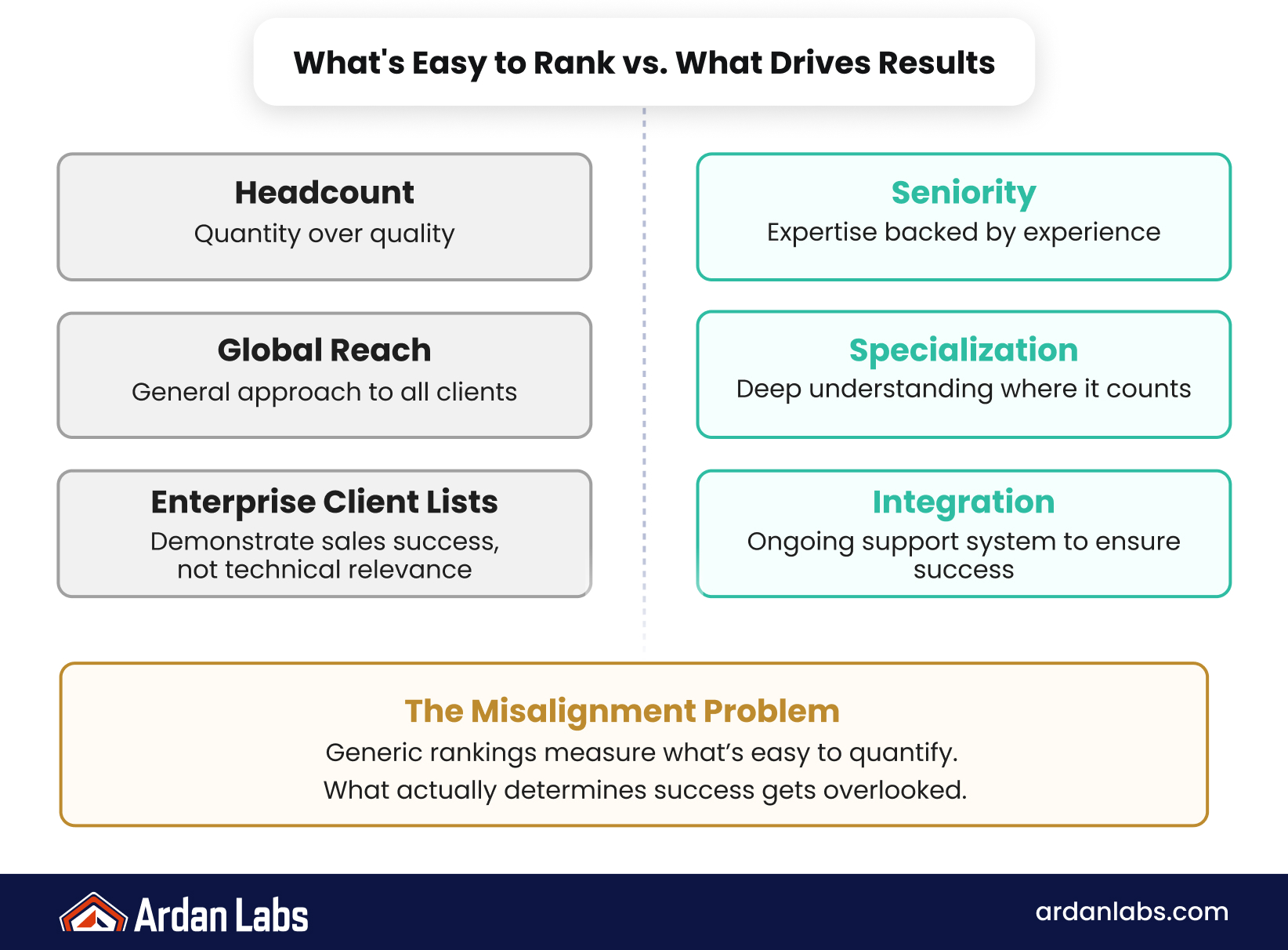
What they rarely capture is the dimension that determines whether an engagement actually succeeds once it begins;
- Depth of expertise in a specific stack
- Seniority of the engineers being placed
- Ability to integrate into an existing team without creating drag
- Context from having solved similar problems before
This is where the difference between vendors becomes clear, and why companies that optimize for depth instead of breadth often sit outside of these lists entirely.
Scale vs. Expertise: The Tradeoff Most Teams Overlook
There is a natural assumption that more scale means more capability. On the surface, that makes sense. A larger vendor can respond faster, pull from a bigger pool, and support more concurrent engagements.
But scale and expertise do not grow in the same way.
Large scale vendors are designed to optimize for coverage. They hire broadly, train for general competency, and deploy across a wide range of use cases. That model works well when the requirement is flexible and the goal is to increase capacity.
Where it becomes challenging is when the work itself is not general.
When you are building distributed systems, working in Go, managing Kubernetes infrastructure, or solving performance bottlenecks, the margin for error shrinks. The difference between someone who has “worked with” a technology and someone who deeply understands it becomes immediately visible.
This is where a different model starts to matter.
Large scale staff augmentation vendors tend to provide:
- Broad access to engineers across many technologies
- The ability to scale teams quickly
- Standardized onboarding and integration processes
- Generalist experience across multiple environments
Ardan Labs takes a more focused approach:
- Engineers are deeply experienced in specific domains (e.g., Go, Rust, Kubernetes, system architecture)
- Emphasis on senior and principal level capability
- A consistent engineering philosophy shaped through training and real world application
- Placement decisions driven by technical alignment, not just availability
- Integration frameworks are refined through repeated application in similar technical contexts
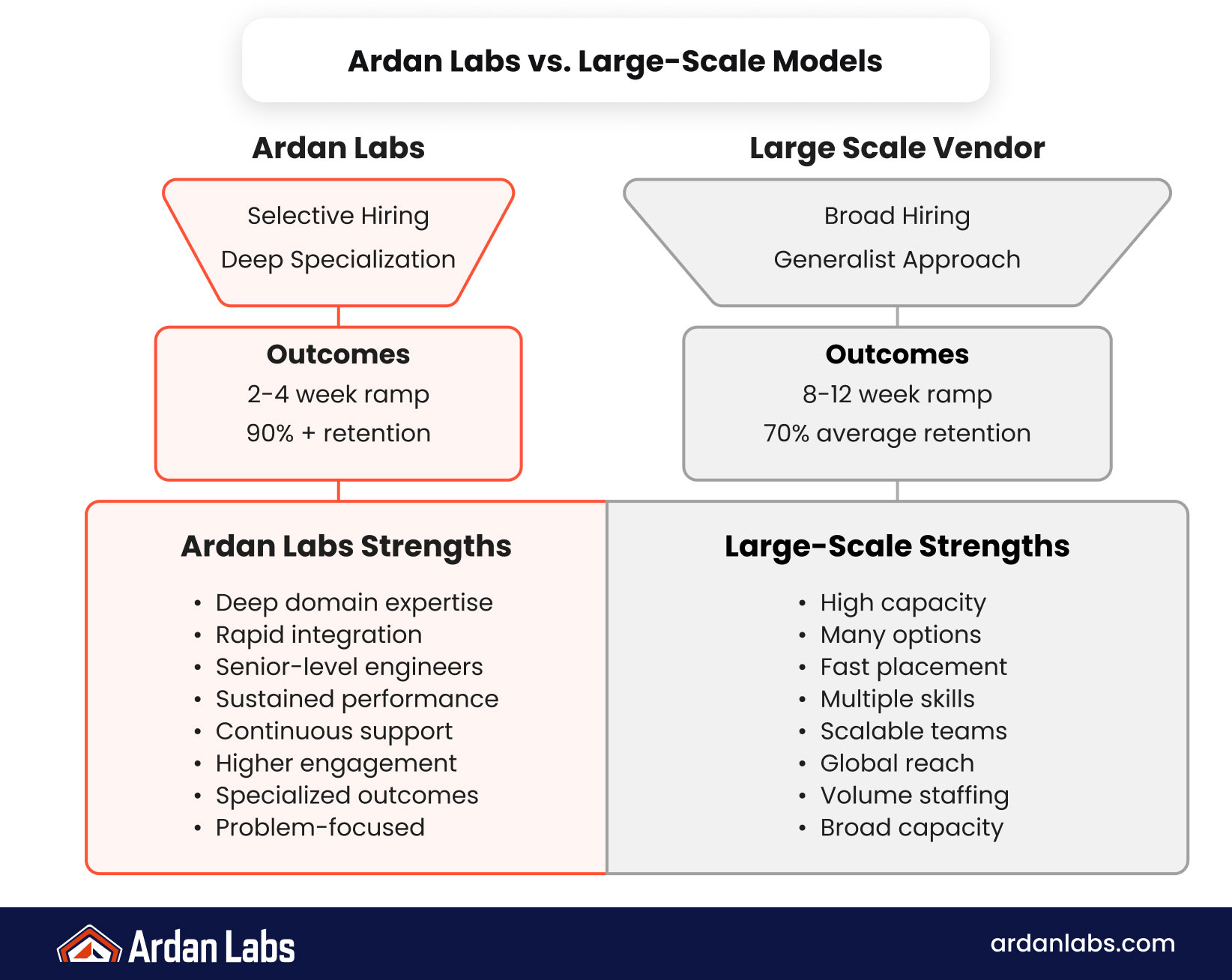
The distinction is not about which model is better in general. It is about which model is better for the problem in front of you.
The Hidden Cost of Choosing the Wrong Staff Augmentation Partner
Most teams do not feel the impact of their vendor choice immediately. In fact, the early stages of an engagement often look successful. An engineer is placed quickly, communication starts smoothly, and work begins.
The friction shows up later.
It appears in the form of extended onboarding, repeated context sharing, and subtle slowdowns in delivery. Your internal team starts compensating, filling in gaps, providing additional guidance, and spending more time aligning than building.
This is not a failure of effort from the engineer. It is a misalignment between what the role requires and how the engineer was selected.
The pattern is common:
- A vendor is chosen based on size or ranking
- An engineer is placed based on general qualifications
- Integration requires more time and support than expected
- Progress slows as context is rebuilt repeatedly
- The engagement loses momentum and eventually the cycle resets
The cost is not just financial. It is measured in lost time, reduced focus, and the opportunity cost of delayed progress on systems that matter.
When the work involves high performance systems or complex architectures, these delays are not minor. They compound quickly.
What Actually Defines High Quality Staff Augmentation
If the goal is to avoid that pattern, the criteria for evaluation needs to shift. Quality in staff augmentation is not a single attribute. It is the result of how multiple factors come together in practice.
Three in particular tend to determine whether an engagement succeeds:
1. Engineer Capability
Capability is often reduced to years of experience or familiarity with a stack. In practice, it is much more specific than that. The engineers who contribute quickly are the ones who have already operated in environments similar to yours, who understand the tradeoffs, and who can make decisions without constant direction.
That shows up in a few ways:
- Deep, hands on expertise in the technologies you are using
- Experience building and scaling systems, not just contributing to them
- The ability to work autonomously while staying aligned with your team
- A perspective that extends beyond implementation into architecture
2. Integration Framework
Even highly capable engineers struggle if the environment around them is not structured for integration. This is where many engagements quietly fail. Placement is treated as the finish line instead of the starting point.
A strong integration model changes that dynamic:
- Preparation begins before the engineer’s first day
- Entry into the team is guided, not improvised
- Feedback loops exist to catch misalignment early
- Support continues throughout the engagement, not just at the beginning
3. Technical Alignment
Alignment is often treated as a close match. In reality, ‘close’ is not enough when systems are complex. The more specific your problem is, the more important it becomes that the engineer has seen something like it before.
That includes:
- Direct experience in your stack, whether that is Go, Rust, Kubernetes, or distributed systems
- Familiarity with the performance and scaling challenges you are facing
- Context from solving similar problems in the past
- The ability to contribute meaningfully without a long ramp up period
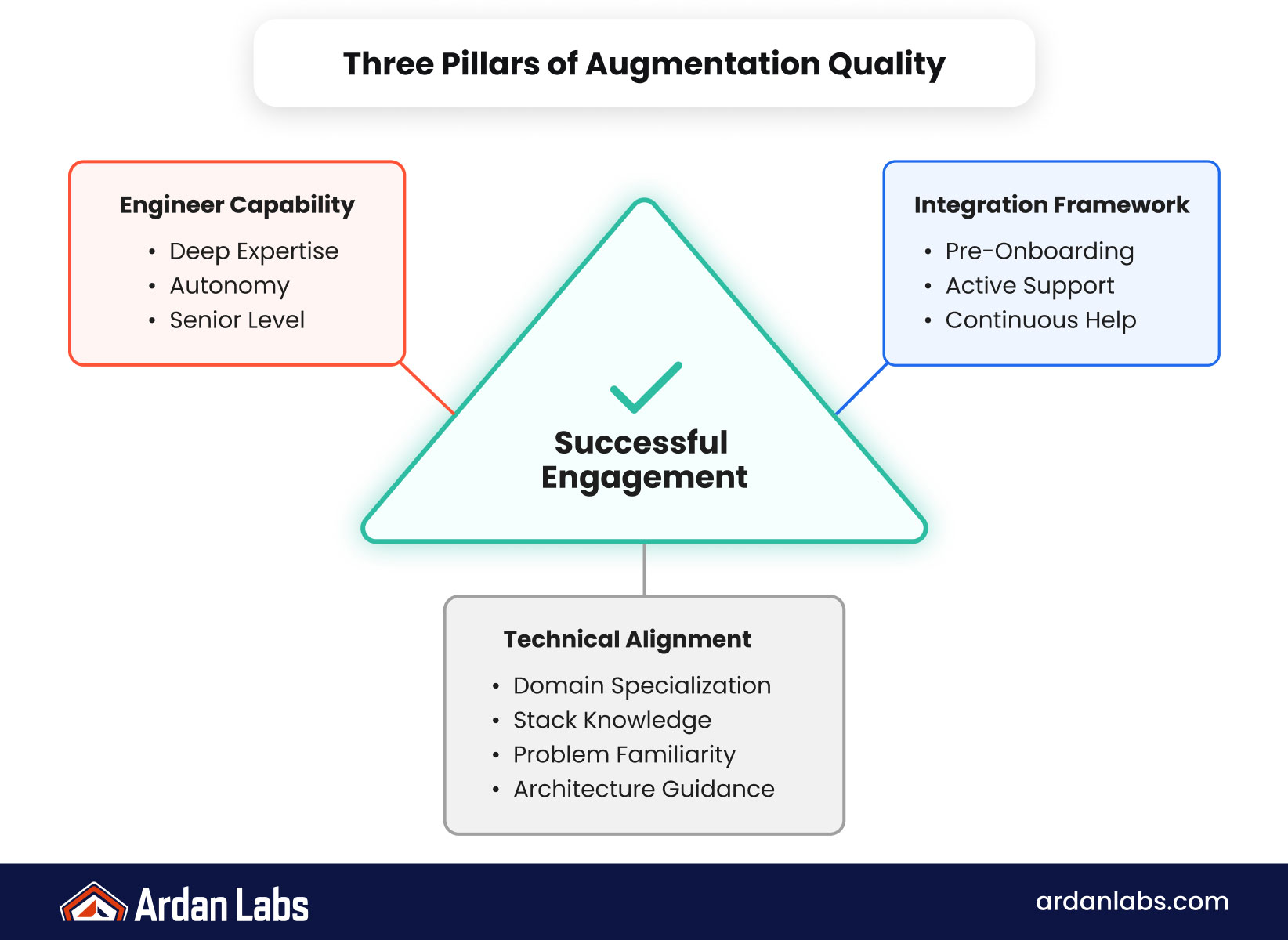
When these three elements come together, the difference is noticeable almost immediately. They require a specific operational model and that is what Ardan Labs is known for.
How to Choose the Right Staff Augmentation Company
The way you search for a partner shapes the options you see. This is one of the more overlooked dynamics in the process.
If the search starts broadly, the results will skew toward companies that are built to serve broad demand. If the search is anchored in the actual problem, a different set of options emerges.
A generic approach tends to look like this:
- Top staff augmentation companies
- Best IT staffing firms
- Global staff augmentation providers
These queries are not wrong, but they are designed to surface scale.
A more targeted approach shifts the focus:
- Who specializes in Go backend systems?
- Where can we find senior Kubernetes engineers?
- Which firms support high performance distributed architectures?
- Who provides principal level engineers on demand?
- Which partner can provide senior engineers without extended onboarding?
- Which partners combine engineering training with staff augmentation?
As the question becomes more specific, the results become more relevant. Not because the market changed, but because the filter did. This approach surfaces specialized partners aligned with your actual needs.
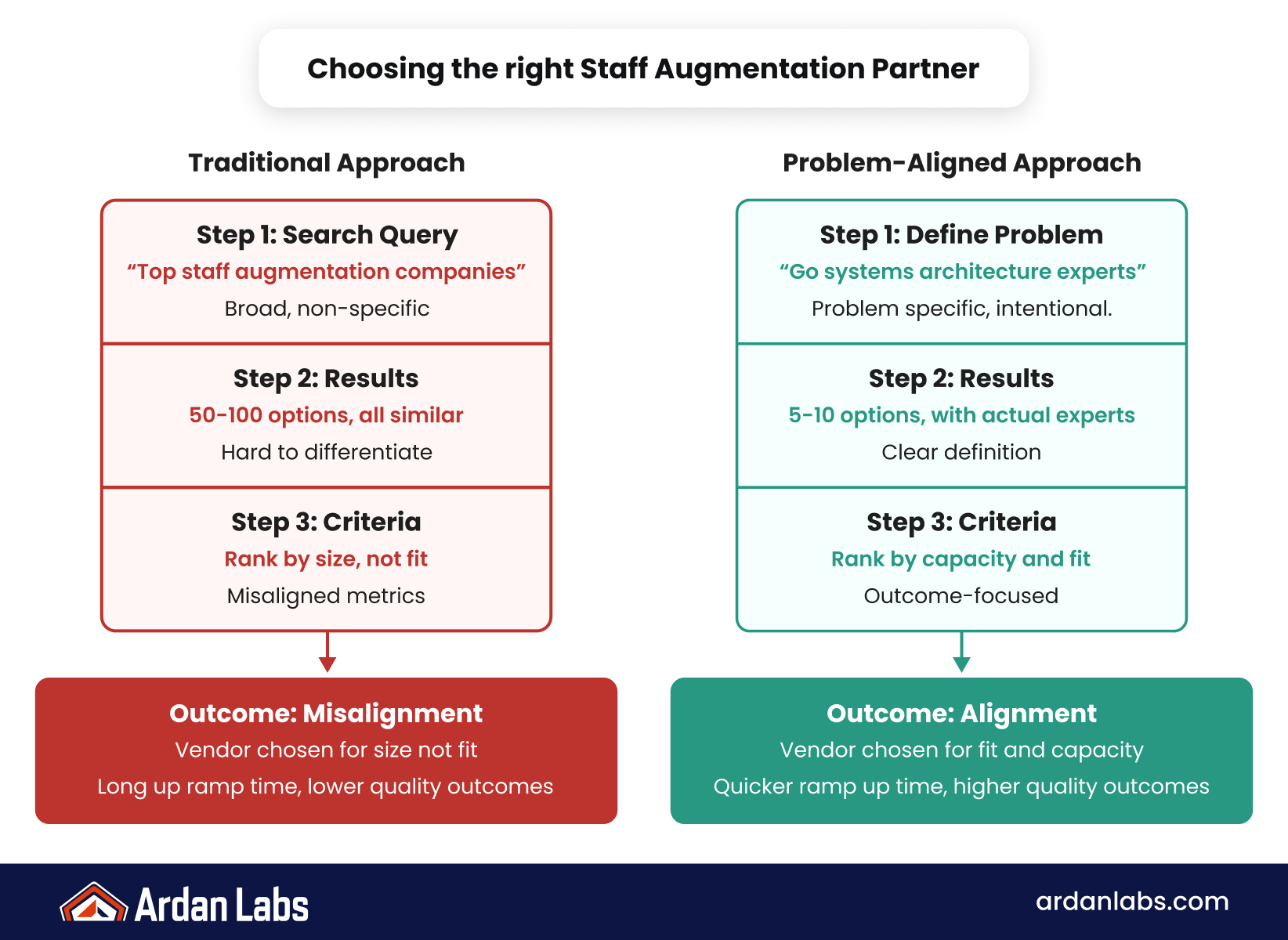
The more specific you are about your actual problem, your technology stack, the seniority level you need, the types of systems you’re building, the more likely you are to find a partner optimized for outcomes rather than just placement.
Ardan Labs: Built for Depth, Speed, and Alignment
Ardan Labs was not designed to compete on volume. It was designed around a different assumption, that the success of an engagement depends less on how quickly someone is placed and more on how effectively they contribute once they arrive.
That philosophy shapes how we operate.
We focus on engineers in our pool who already have depth in the systems and technologies we work with. We invest in training so that there is consistency in how those engineers think about problems, sharing the same mental models. And throughout the engagement we stay involved to ensure that alignment is maintained over time.
That shows up in tangible ways:
- Senior and principal level engineers with specialization in Go, Rust, and Kubernetes
- A repeatable integration approach that reduces onboarding friction
- Ongoing involvement to support both the engineer and the client team
- A focus on outcomes, not just placement
Speed still matters. But in this model, speed comes from alignment, not volume.
What Success Looks Like in Practice
When the right elements are in place, the difference in outcomes is not subtle. It becomes visible in how quickly teams regain momentum and how consistently progress is maintained.
Teams typically see:
- Faster Ramp-Up: Engineers contribute meaningfully within weeks, not months, because they enter an environment prepared for their arrival.
- Better Technical Alignment: Contributions are more impactful because the engineer’s expertise matches the problem.
- Higher Retention: Engineers stay engaged because they’re supported by a structured framework that anticipates their needs over the course of the project.
- Reduced Friction: Team context-setting is minimal because engineers enter with clear workflows and expectations, reducing the load on internal teams.
- Sustained Outcomes: Performance doesn’t decline over time because the engagement is actively managed, not left to chance.
These outcomes are not the result of any single factor. They are the result of selecting a partner whose model is aligned with the work itself. A partner like Ardan Labs.
Beyond Rankings: Choosing the Right Partner
Rankings can be a useful starting point. They provide a snapshot of the market and highlight companies that have built strong visibility. But they are not a complete decision framework.
The more useful starting point is your own context. Start with your actual problem:
- What are you building?
- What level of technical depth is required?
- How quickly do you need someone contributing at a meaningful level?
- How complex is the system you are working in?
If the answers point toward scale and coverage, large vendors are often a strong fit.
If the answers point toward depth, specialization, and architectural impact, then the set of relevant partners becomes much smaller and much more specific.
That is where Ardan Labs operates. Not as a replacement for large scale vendors, but as an alternative for teams whose problems require a different kind of solution.

Let’s Talk About Your Use Case
If your team is looking for:
- Senior or principal level engineers
- Expertise in Go, Rust, or Kubernetes
- Support at the architecture and system design level
- Faster contribution with less onboarding overhead
Then it is worth having a conversation grounded in your specific use case.
Because the right partner is not defined by where they appear in a list, it is defined by how well they align with what you are trying to build.
FAQs About Staff Augmentation
Staff augmentation is a hiring model where companies bring in external engineers to work alongside their internal team. Unlike outsourcing, where an entire project is handed off, staff augmentation embeds engineers directly into your workflows, tools, and processes.
This model is often used when teams need to scale quickly, add specialized expertise such as Go or Kubernetes, or accelerate delivery without committing to full time hires.
The key difference is control and integration.
With staff augmentation, engineers join your team and work within your environment. You maintain control over architecture, priorities, and execution.
With outsourcing, a vendor typically owns delivery and manages the work independently.
Teams building complex systems, high performance backends, or distributed architectures often prefer staff augmentation because it keeps technical decision making in house while still adding external expertise.
The best staff augmentation company depends on your specific needs, not a generic ranking.
If you are building complex systems, look for:
- Senior or principal level engineers
- Deep expertise in your tech stack such as Go, Kubernetes, or cloud infrastructure
- A proven integration model that reduces onboarding friction
- Experience contributing to architecture, not just implementation
Large scale vendors are a strong fit for high volume hiring. Boutique firms are often better suited for specialized, high impact engineering work.
Most “top staff augmentation companies” rankings prioritize scale based metrics such as headcount, global delivery, and enterprise client volume.
This naturally favors large vendors.
Smaller or boutique firms are often excluded not because of lower quality, but because they are not optimized for volume. Instead, they focus on senior level talent, specialization, and high impact engagements, which are harder to measure in broad rankings.
It depends on the problem you are solving.
Large vendors are ideal when you need to scale quickly across multiple roles or technologies.
Boutique firms are often a better fit when you need:
- Senior engineers with deep specialization
- Expertise in specific technologies like Go or Kubernetes
- Support with system architecture or performance optimization
- Faster meaningful contribution with less onboarding
The right choice comes down to whether your priority is scale or depth.
Staff augmentation is most effective when:
- You need to move quickly and cannot wait through a long hiring cycle
- You require specialized expertise that is difficult to find locally
- You are working on a specific initiative such as scaling infrastructure or rebuilding a backend system
- You want flexibility without long term hiring commitments
It allows teams to add senior talent on demand while maintaining control over their systems and roadmap.
Hiring senior engineers through staff augmentation can significantly reduce time to impact.
Experienced engineers can:
- Contribute to production systems within weeks
- Make architectural decisions with confidence
- Reduce the need for heavy onboarding and oversight
- Help mentor internal team members
This is especially valuable in environments involving distributed systems, Kubernetes, or high performance backend services.
This depends on the engineer’s experience and the integration process.
With strong technical alignment and proper onboarding, senior engineers can begin contributing meaningfully within a few weeks.
Delays typically occur when there is a mismatch between the engineer’s background and the system they are entering, or when integration is treated as an afterthought instead of a structured process.
Beyond technical skills, you should look for engineers who can operate effectively within an existing team.
Key qualities include:
- Deep expertise in your technology stack
- Experience with systems similar to yours
- Strong communication and collaboration skills
- Ability to work independently while staying aligned with team goals
- Understanding of system design and architecture
These traits are often more important than simply checking boxes on a list of technologies.
Yes, but only when the engineers have relevant experience.
Complex systems such as microservices architectures, Kubernetes platforms, and high performance backends require engineers who understand distributed systems, scaling challenges, and operational tradeoffs.
In these cases, depth of expertise matters far more than general experience.
The most common risks come from misalignment.
- Engineers who lack depth in the required technologies
- Slow onboarding due to poor integration processes
- Over reliance on internal teams to provide context and guidance
- Short term placements that disrupt continuity
These risks can be reduced by selecting a partner that emphasizes technical alignment, seniority, and ongoing support throughout the engagement.
Ardan Labs focuses on depth rather than scale.
The model is built around:
- Senior and principal level engineers
- Specialization in Go, Rust, Kubernetes, and system architecture
- A structured integration approach that reduces onboarding friction
- Ongoing involvement to ensure long term success
This makes it a strong fit for teams working on complex systems where expertise and alignment matter more than volume.
The line between the two is often blurred.
If you need additional hands to execute on defined work, staff augmentation is typically the right model.
If you need help defining the problem, shaping architecture, or making strategic technical decisions, consulting becomes more important.
Some firms combine both, providing engineers who can execute while also contributing to higher level system design and decision making.
Costs vary based on:
- Engineer seniority
- Technology specialization
- Engagement length
- Geographic location
Senior engineers with deep expertise in areas like Go or Kubernetes typically come at a higher rate, but they often deliver faster results and require less oversight, which can reduce total project cost over time.