
Growth is where most engineering challenges begin. As products gain traction and systems evolve, complexity increases faster than most teams expect. What once felt manageable starts to strain under new demands. This article gives you a practical way to compare three common models and to pick the one that fits your constraints, not just your preferences.
Quick Decision Guide for Engineering Leaders
When pressure is high, decisions rarely start with theory. They start with constraints.
- Need immediate execution speed while retaining control → Staff augmentation
- Need to offload clearly defined work → Outsourcing
- Need long-term ownership and capability → Hiring
This initial framing gives you direction. But the real decision comes from understanding how each model behaves once it meets the realities of your systems, your team, and your timelines.
Choosing Between Staff Augmentation, Outsourcing, & Hiring
At that point, the question is no longer whether to scale, but how.
Do you invest in long-term capability through hiring, delegate work externally through outsourcing, or extend your team with specialized expertise through staff augmentation?
Each path solves a different problem. Each introduces different tradeoffs. And each shapes how work moves through your organization in ways that are not always obvious at the start.
The difference is not just who does the work. It is how closely that work stays connected to your system.
Staff Augmentation: Extending Your Engineering System
What Is Staff Augmentation and When Should You Use It
Staff augmentation is often misunderstood because it looks simple on the surface. You bring in engineers, they contribute, and capacity increases.
In practice, it is far more nuanced. Staff augmentation works because it keeps execution inside your system. Engineers do not operate on the outside delivering work back to you. They operate within your environment, alongside your team, contributing directly to your codebase and decisions.
This distinction matters. The closer work stays to your system, the more control you retain over quality, architecture, and direction.
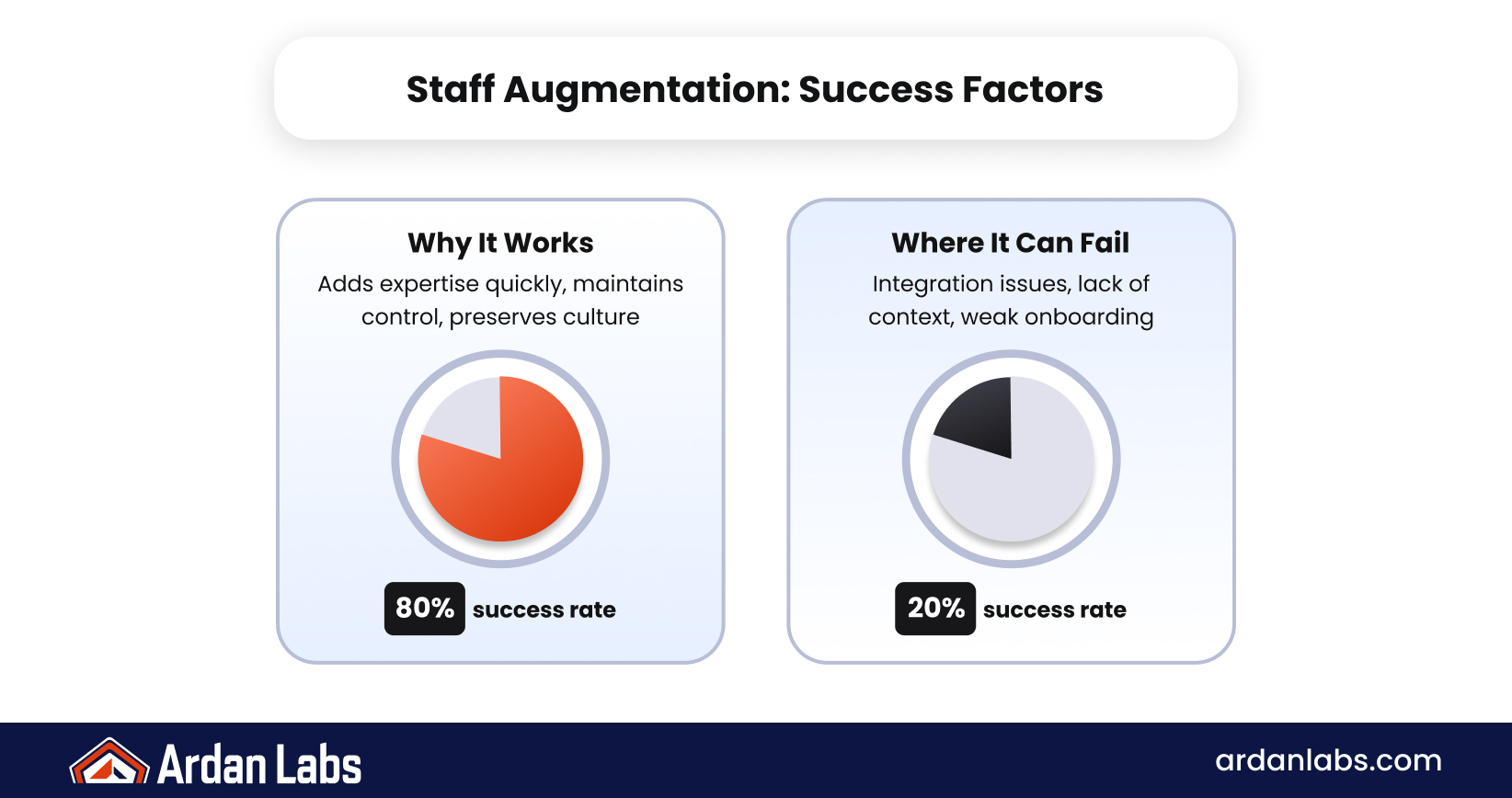
Why It Works
- Adds specialized expertise quickly without lengthy hiring cycles
- Maintains control over architecture and quality
- Preserves team culture and operational rhythm
Hiring delays make this even more relevant. More than 75 percent of companies report difficulty hiring skilled engineers, and specialized roles often take months to fill. Staff augmentation exists to close that gap without slowing execution.
Market insight: Over 75 percent of companies report difficulty hiring IT specialists (techtronixcorp.com). Hiring cycles for specialized roles often take three to six months or more. Global staff augmentation spend is projected to reach approximately 81.9 billion dollars (secondtalent.com).
Where It Can Fail
The model itself is not the risk. The integration is.
When engineers arrive without context, unclear expectations, or structured onboarding, they become observers instead of contributors. Teams spend time compensating instead of accelerating.
- Lack of context slows decision making
- Weak onboarding creates friction
- Misalignment delays impact
High Performing Integration
This is where high performing teams separate themselves. They treat integration as a system, not an afterthought. Engineers who are aligned before they arrive contribute differently than those who are not. They understand expectations, workflows, and constraints from the start.
Ardan Labs applies this principle directly by preparing engineers before they join a team. This early alignment reduces ramp up time, eliminates common friction points, and allows teams to maintain momentum instead of pausing to onboard.
Real World Scenario: High Growth Fintech
A fintech platform scaling transaction processing reached a point where demand outpaced internal capacity. The system was too critical to risk misalignment, and timelines were too aggressive to wait for hiring cycles.
Outsourcing would have created distance from the core system. Hiring would have introduced delay.
Staff augmentation offered a middle path. Engineers were integrated directly into the team, aligned to the system, and contributing within weeks.
Outcome:
- Increased delivery velocity
- Maintained architectural control
- No added production risk
This is where staff augmentation consistently proves its value. It allows teams to move faster without letting go of the system they are responsible for.
Outsourcing: Delegating Execution
What Is Outsourcing and When Does It Make Sense
Outsourcing operates on a different principle. Instead of extending your system, it creates separation from it.
Work is handed off to an external team with the expectation that it will be delivered according to defined requirements. This can be powerful when the problem is stable and clearly understood.
But that separation changes how work flows. Communication becomes more structured. Iteration slows. Context is reduced.
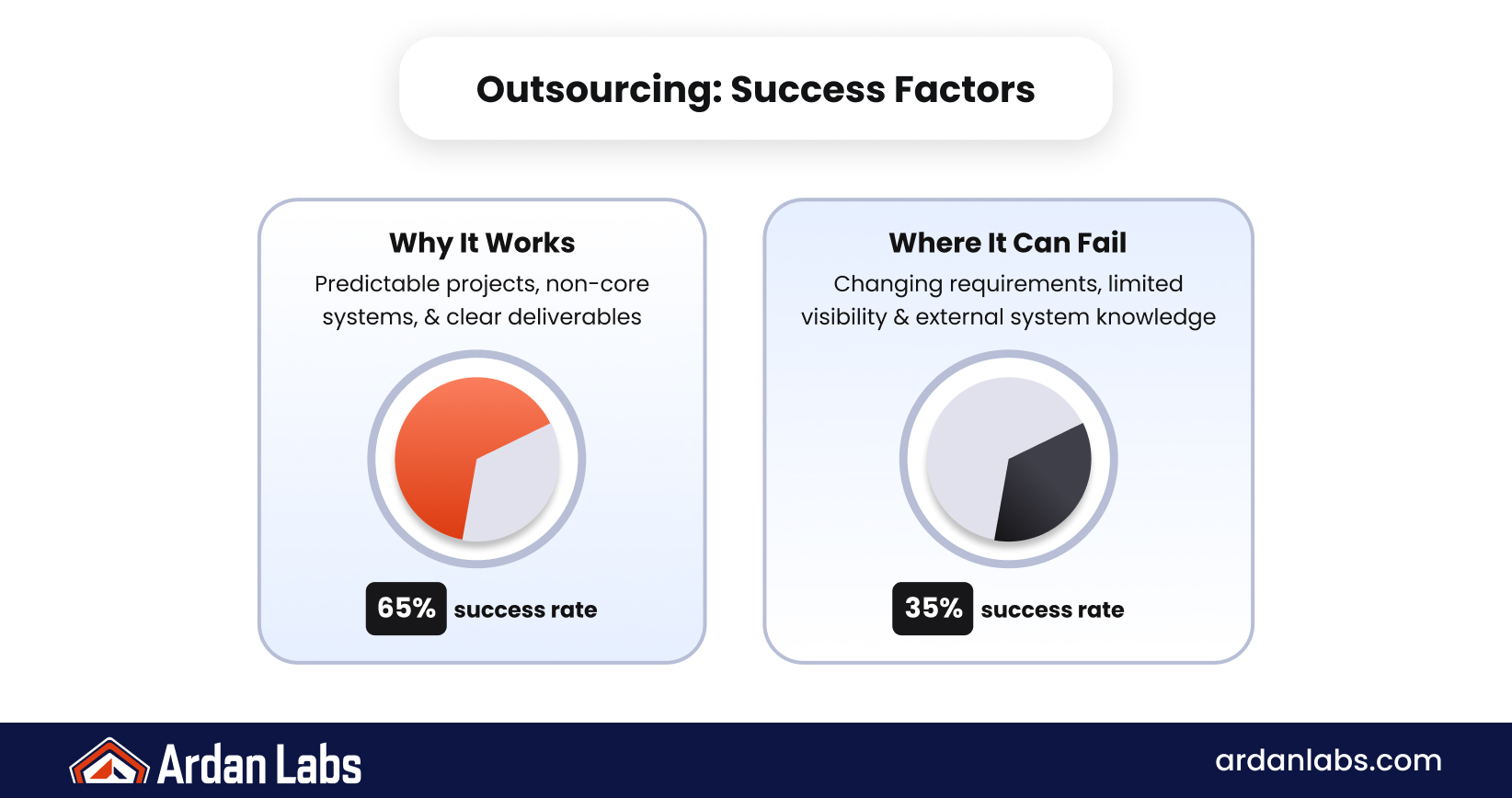
Why It Works
- Predictable projects with stable requirements
- Work that is not tightly coupled to core systems
- Clearly defined deliverables
Where It Can Fail
Outsourcing struggles when reality shifts, which it often does.
- Changing requirements require re-alignment
- Limited visibility slows iteration
- System knowledge remains external
The more a project depends on evolving context, the more this separation becomes a constraint rather than a benefit.
High Performing Integration
Outsourcing performs best when there is strong upfront alignment on scope, communication protocols, and success criteria. Clear documentation, structured reporting, and well-defined delivery checkpoints help reduce ambiguity and improve execution consistency.
When these foundations are in place, outsourcing can operate as a reliable extension for well-bounded areas of work.
Market insight: The global outsourcing market is projected to exceed 591 billion dollars (secondtalent.com).
Real World Scenario: Retail Inventory System
A retailer outsourced an internal inventory tool to reduce pressure on its core engineering team. The project was well defined, and initial delivery met expectations.
But over time, the limitations became clear.
As the system needed to integrate more deeply with internal platforms, the lack of shared context slowed progress. Changes required additional coordination. What was efficient at the start became restrictive later.
This is the tradeoff outsourcing introduces. It simplifies execution early but can complicate adaptation later.
Hiring: Full Time Engineers Building Long Term Capability
When to Hire Full Time Engineers for Long Term Growth
Hiring is fundamentally different from both augmentation and outsourcing. It is not about immediate execution. It is about building lasting capability.
Full time engineers accumulate system knowledge over time. They understand the architecture, the tradeoffs, and the history behind decisions. That depth creates stability and ownership that external models cannot fully replicate.
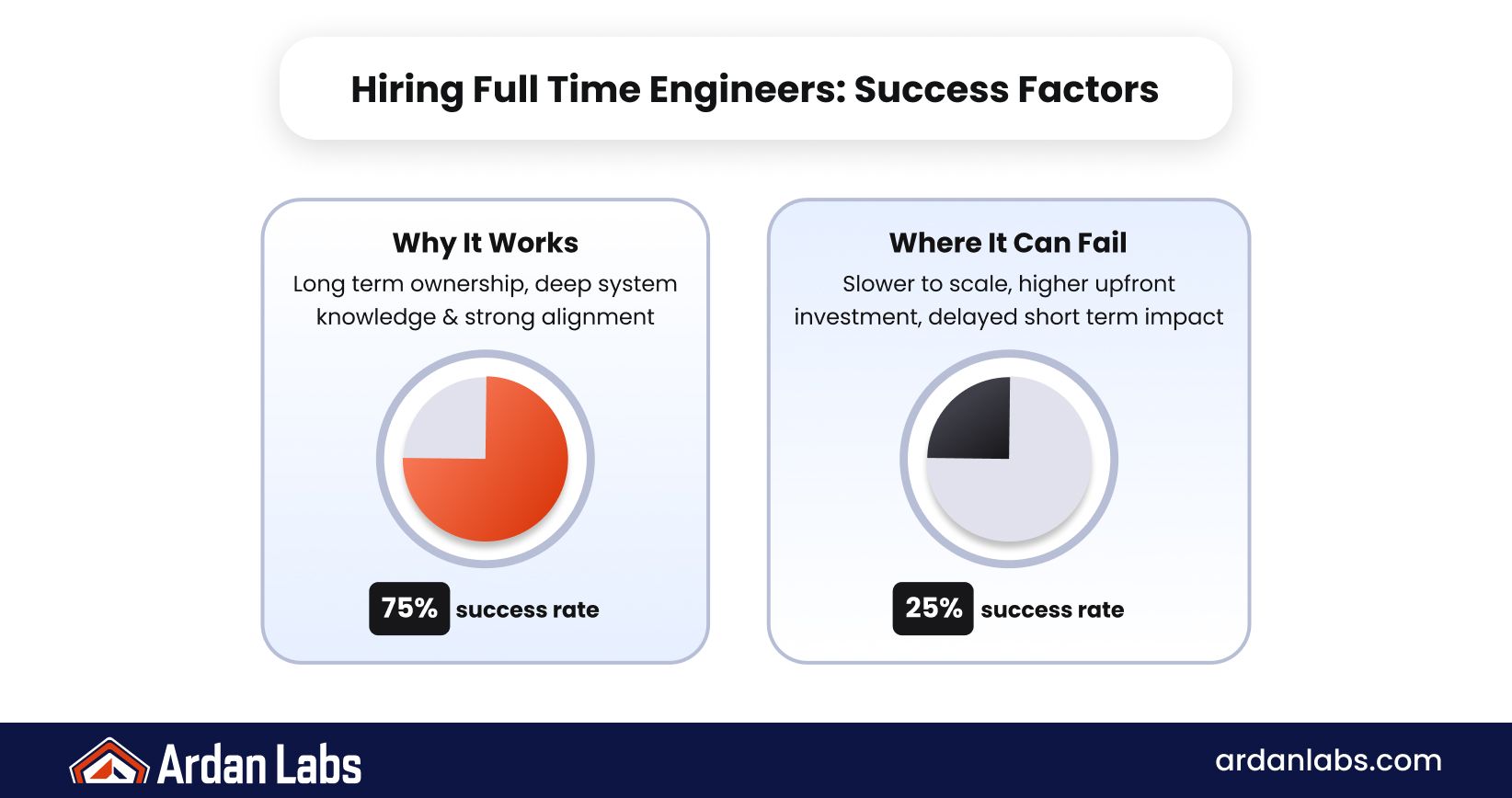
Why It Works
- Long-term ownership and accountability
- Deep system knowledge
- Strong alignment with company goals
Where It Can Fail
- Slower to scale
- Higher upfront investment
- Delayed short-term impact
Hiring is a long game. It pays off over time, but it does not solve immediate execution pressure.
High Performing Integration
Hiring works best when organizations are prepared to invest in structured onboarding, clear role definitions, and long-term alignment with product strategy. When supported correctly, full-time engineers become deeply embedded in the system, contributing not only to execution but also to the long-term evolution of the platform.
Real World Scenario: SaaS Core Platform
A SaaS company investing in its core data infrastructure chose to hire a dedicated team. The work required deep system understanding and long-term ownership.
Early progress was slower compared to augmentation. But over time, the benefits became clear.
The team developed strong domain expertise, reduced reliance on external support, and improved system stability.
This is where hiring excels. Not in speed, but in durability.
Side by Side Comparison
Staff Augmentation vs Outsourcing vs Hiring: Key Differences
| Factor | Staff Augmentation | Outsourcing | Hiring |
|---|---|---|---|
| Speed to Impact | High | Medium | Low |
| Control | High | Low to Medium | High |
| Flexibility | High | Medium | Low |
| System Context | Fully integrated | Limited | Fully integrated |
| Best Use Case | Scaling execution | Offloading work | Building capability |
Each model is not just a different option. It is a different way of organizing work, ownership, and control.
Practical Decision Framework
A Decision Framework for CTOs and Engineering Leaders
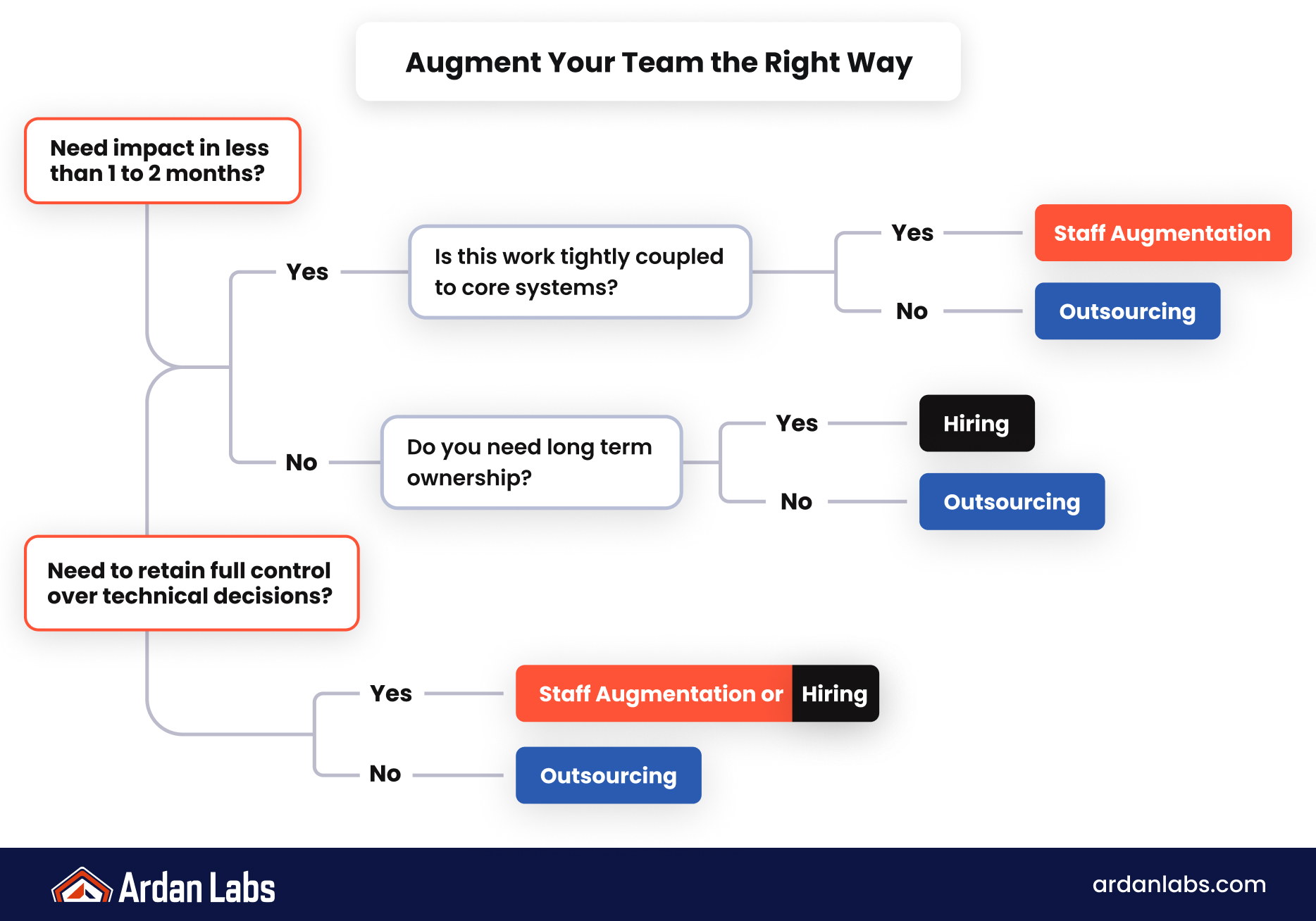
When time is limited, simplify the decision to what matters most.
- Urgency: How quickly do you need impact?
- System Coupling: How connected is the work to your core systems?
- Context Requirement: How much internal knowledge is required?
- Ownership: Is this temporary execution or long-term capability?
- Management Capacity: Can your team support external contributors?
Patterns emerge quickly:
- High urgency and high coupling → Staff augmentation
- Low coupling and clear scope → Outsourcing
- Long-term ownership → Hiring
The right decision becomes clearer when you align the model to the constraint, not preference.
Visual Decision Tree

Execution Is the Strategy
Choosing the Right Model for Speed, Control, and Growth
At first glance, staff augmentation, outsourcing, and hiring appear to be resourcing decisions. In reality, they are execution strategies that shape how your team moves, adapts, and delivers.
- Staff augmentation maximizes speed and control
- Outsourcing maximizes delegation and focus
- Hiring maximizes long term ownership and knowledge
The most effective teams are not committed to one model. They understand when each one applies.
Staff augmentation works best when engineers are integrated into your team from day one, supported by clear processes and alignment. As explored in How Ardan Labs Integrates Senior Engineers through Staff Augmentation, well prepared engineers reduce ramp up time, minimize friction, and keep projects moving forward. When execution speed and control matter, partnering with an organization that treats integration as a core discipline can make a measurable difference.
Because in the end, adding engineers is not the goal. Maintaining momentum is.
If you're considering staff augmentation and want a partner focused on outcomes, not just placement, let's talk.
Frequently Asked Questions
Staff augmentation integrates external engineers directly into your team, allowing you to maintain control over architecture, workflows, and execution. Outsourcing delegates work to an external team, creating separation from your internal systems and processes. Hiring brings full time engineers into your organization to build long term capability and ownership. Learn more about how this works in practice in our staff augmentation guide. The key difference is how closely the work stays connected to your system and team.
Staff augmentation is best when you need to increase execution speed without losing control over your systems. It is especially effective for projects that are tightly coupled to your core architecture and require close collaboration with your internal team. For a deeper breakdown of how engineers integrate quickly, see How Ardan Labs Integrates Senior Engineers Through Staff Augmentation. It is often used during periods of rapid growth, tight deadlines, or when specialized expertise is needed quickly.
Outsourcing works best for projects that are clearly defined, stable, and not deeply connected to your core systems. It is ideal when you want to reduce internal workload and delegate execution without requiring constant collaboration. For a comparison with other models, refer to this guide. However, it is less effective when requirements are evolving or when deep system knowledge is required.
Hiring full time engineers involves sourcing, interviewing, onboarding, and ramping up new team members. This process can take several months, especially for specialized roles. While hiring provides long term value through ownership and system knowledge, it does not address immediate execution needs as quickly as staff augmentation. You can compare timelines and tradeoffs in our article on staff augmentation vs outsourcing vs hiring.
The primary risk of staff augmentation is poor integration. Without clear onboarding, alignment, and expectations, even experienced engineers may take longer to contribute effectively. Teams that treat integration as a structured process see significantly better outcomes. Learn more about effective integration practices in How Ardan Labs Integrates Senior Engineers Through Staff Augmentation.
When done correctly, staff augmentation supports and extends team culture rather than disrupting it. Engineers who are integrated into workflows, communication channels, and team expectations can operate as true contributors. The key is ensuring alignment from day one. For more on how integration supports team dynamics, see How Ardan Labs Integrates Senior Engineers Through Staff Augmentation.
Staff augmentation can be more cost effective in the short term because it eliminates long hiring cycles and allows companies to scale resources based on immediate needs. Hiring, while more expensive upfront, provides long term value through retained knowledge and ownership. Explore a full comparison in staff augmentation vs outsourcing vs hiring.
Yes. High performing engineering organizations often use a combination of all three models. For example, they may hire for core system ownership, use staff augmentation to accelerate execution, and outsource well defined, non core work. Learn how to apply this hybrid approach in staff augmentation vs outsourcing vs hiring.
With proper preparation and onboarding, staff augmentation engineers can begin contributing within days or weeks. Teams that invest in pre onboarding and alignment see faster impact. See how structured onboarding improves speed in How Ardan Labs Integrates Senior Engineers Through Staff Augmentation.
Success depends on treating integration as a system. This includes clear expectations, alignment with workflows and architecture, and structured onboarding. Preparation before engineers join a team plays a critical role in reducing ramp up time and maintaining momentum. Learn more about this approach in How Ardan Labs Integrates Senior Engineers Through Staff Augmentation.