AI Changed How Engineering Organizations Scale Software Teams
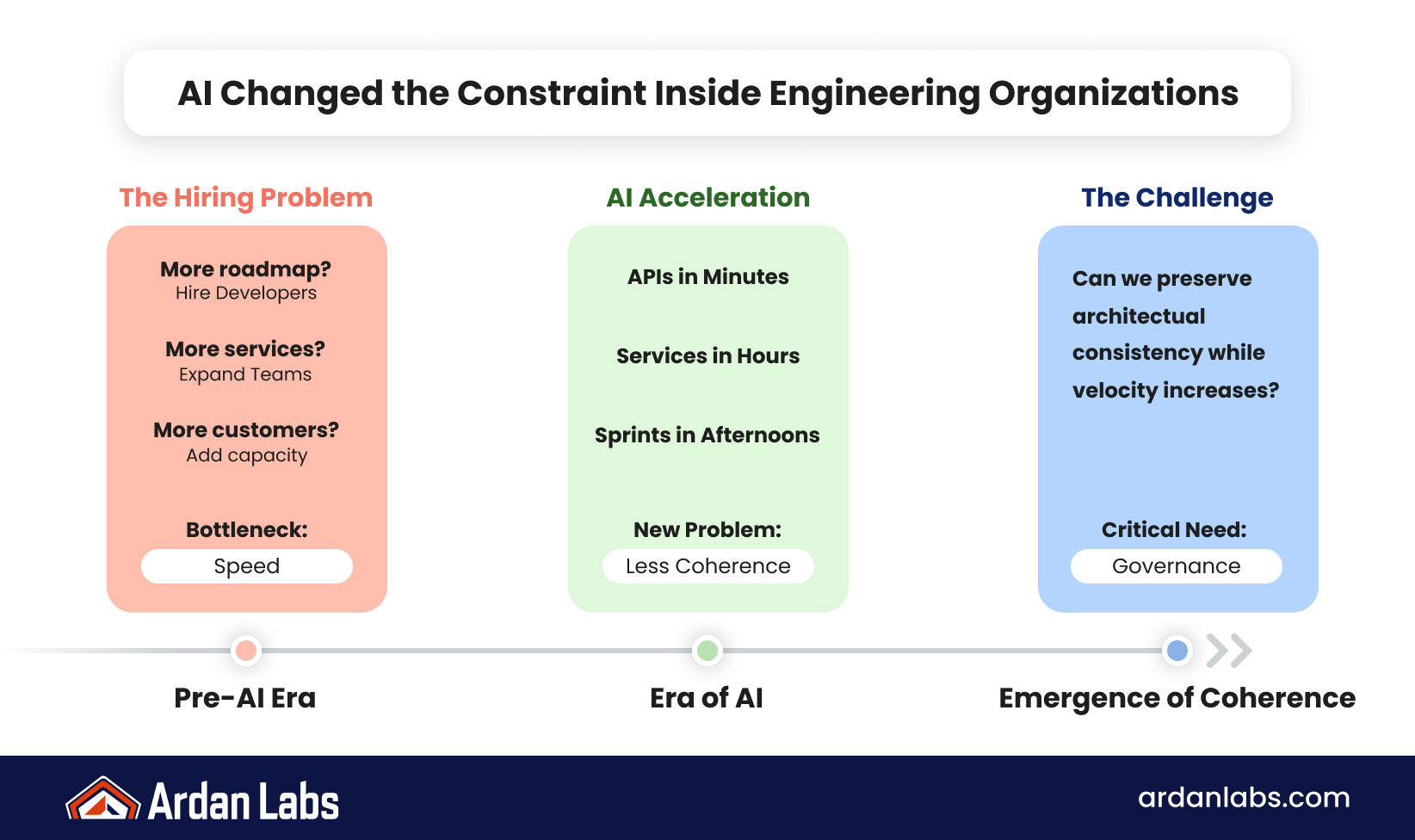
For years, scaling an engineering organization was mostly a hiring problem.
More roadmap pressure meant hiring more developers. More backend services meant expanding platform teams. More customer growth meant increasing implementation capacity fast enough to keep delivery moving.
AI changed that equation almost overnight.
Today, engineering teams can generate meaningful amounts of backend code faster than at any point in software history. APIs can be scaffolded in minutes. Internal services can be prototyped in hours. Routine implementation work that once consumed entire sprints can now happen inside a single afternoon. That’s no secret.
At first, this feels like a straightforward productivity breakthrough.
And in many ways, it is.
But many CTOs are now discovering a second order effect that is harder to see initially: systems are becoming more difficult to reason about even while teams are shipping faster.
This is the operational tension increasingly shaping modern engineering leadership.
The problem is no longer whether teams can produce code quickly. AI already accelerated that dramatically. The problem is whether organizations can preserve architectural consistency, operational clarity, and long term maintainability while development velocity increases around them.
Because faster output alone does not create healthy systems. Coherence does.
And coherence becomes significantly harder to maintain once implementation speed begins outpacing the organization’s ability to govern architectural decisions consistently.
AI Accelerated Development Is Increasing Architectural Drift
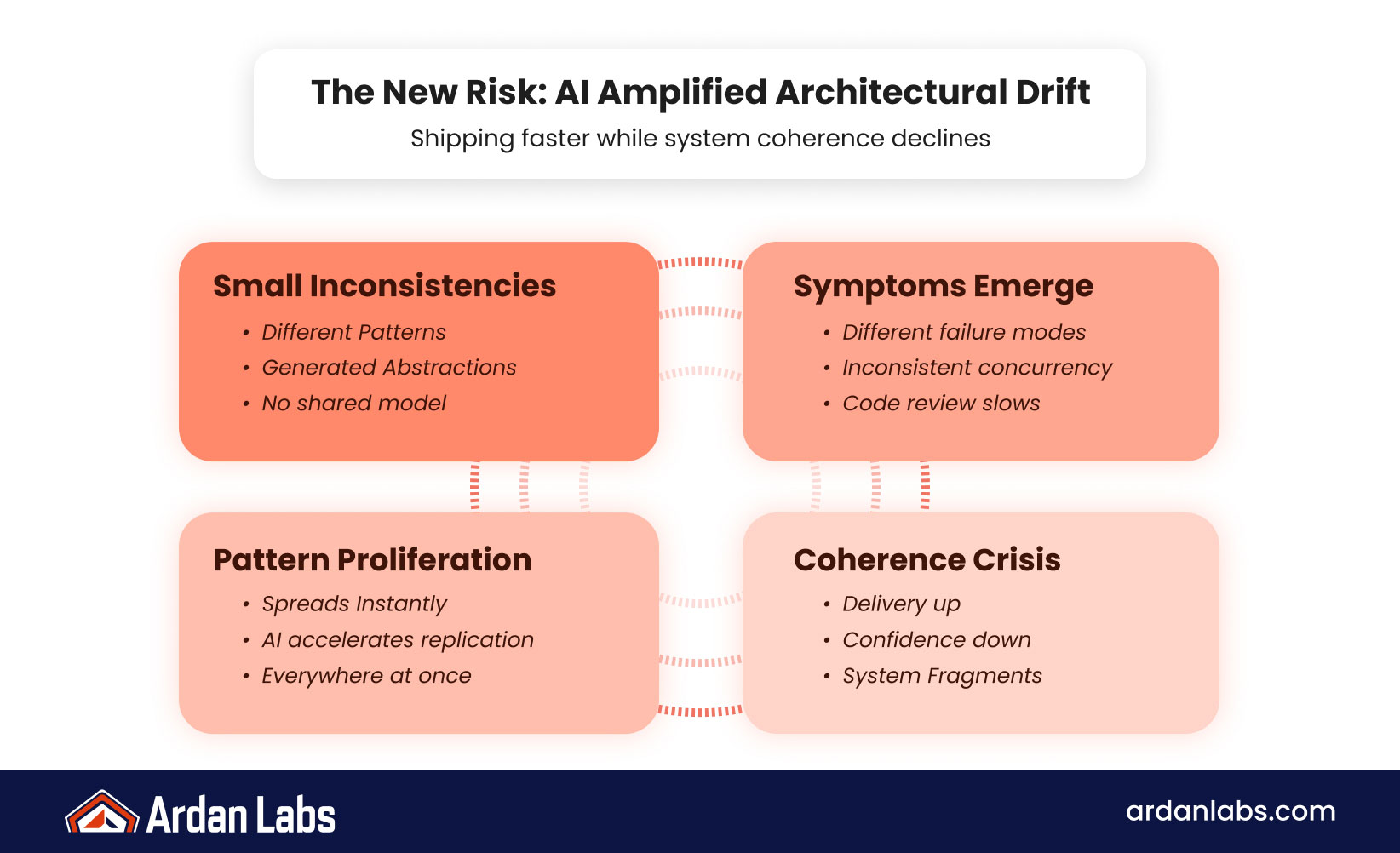
Most architectural degradation does not begin with catastrophic technical decisions. It usually begins with small inconsistencies that seem harmless in isolation.
A slightly different concurrency pattern in one service. A generated abstraction introduced to accelerate delivery. A retry mechanism copied between repositories without a shared operational model underneath it. A new engineer solving an existing problem differently because the system’s architectural boundaries were never made explicit.
None of these decisions feel dangerous during implementation. In fact, most of them appear reasonable during code review.
That is precisely why architectural drift becomes difficult to detect early.
AI accelerates this process because it increases the speed at which implementation patterns spread across a platform. What once evolved gradually through human repetition can now propagate almost instantly through generated code and accelerated development workflows.
Teams often begin noticing subtle symptoms first:
- similar services behaving differently under failure conditions
- inconsistent concurrency ownership models across repositories
- duplicated infrastructure logic emerging between teams
- generated abstractions solving identical problems differently
- code reviews focusing on syntax correctness instead of operational consistency
Individually, these issues rarely trigger alarm. Collectively, they create systems that become harder to evolve safely over time.
This is where many engineering organizations begin experiencing a quieter kind of operational anxiety. Delivery metrics still look strong. Pull requests move quickly. Teams appear highly productive.
Yet confidence in the long term maintainability of the platform begins decreasing at the exact same time.
The architecture slowly stops feeling intentional. Not broken. Just increasingly fragmented.
That contradiction is becoming one of the defining engineering leadership challenges of the AI era.
Why Go Systems Expose Drift Earlier
Go systems often make architectural inconsistency visible faster than many other ecosystems because the language itself is intentionally biased toward simplicity.
Go rewards:
- explicit behavior
- clear ownership
- operational predictability
- straightforward code paths
- composable concurrency
- minimal abstraction
When engineering teams preserve those characteristics, Go systems tend to age remarkably well. Services remain understandable under growth. Operational debugging stays manageable. Engineers can onboard quickly because the platform continues feeling coherent over time.
But those benefits are fragile.
They depend heavily on engineering discipline and shared architectural judgment.
Without that discipline, complexity begins entering the system indirectly. Engineers import abstractions from other ecosystems. AI generated implementations reinforce patterns that are syntactically correct but operationally inconsistent with how the broader platform behaves.
Concurrency is one of the clearest examples of this.
AI is exceptionally effective at generating goroutines, channels, and asynchronous workflows that appear valid during local review. The implementations compile cleanly. Unit tests pass. Initial throughput often improves.
The problem is that concurrency failures rarely emerge immediately. They emerge under production pressure.
A cancellation boundary behaves differently under real traffic. Goroutines outlive the lifecycle they were supposed to belong to. Retry behavior compounds unexpectedly during downstream latency spikes. Ownership becomes unclear across service boundaries.
What looked correct locally creates instability globally. This is where experienced Go engineers become disproportionately valuable.
Not because they can generate goroutines faster than AI, but because they recognize:
- when concurrency should not exist in the first place
- where lifecycle ownership becomes ambiguous
- how cancellation propagates operationally across systems
- which abstractions will become maintenance liabilities later
- when generated simplicity is masking deeper architectural inconsistency
That type of judgment rarely comes from syntax familiarity alone.
It comes from operating production systems long enough to experience the consequences of architectural drift firsthand.
Why Senior Engineers Are Becoming Architectural Stabilizers
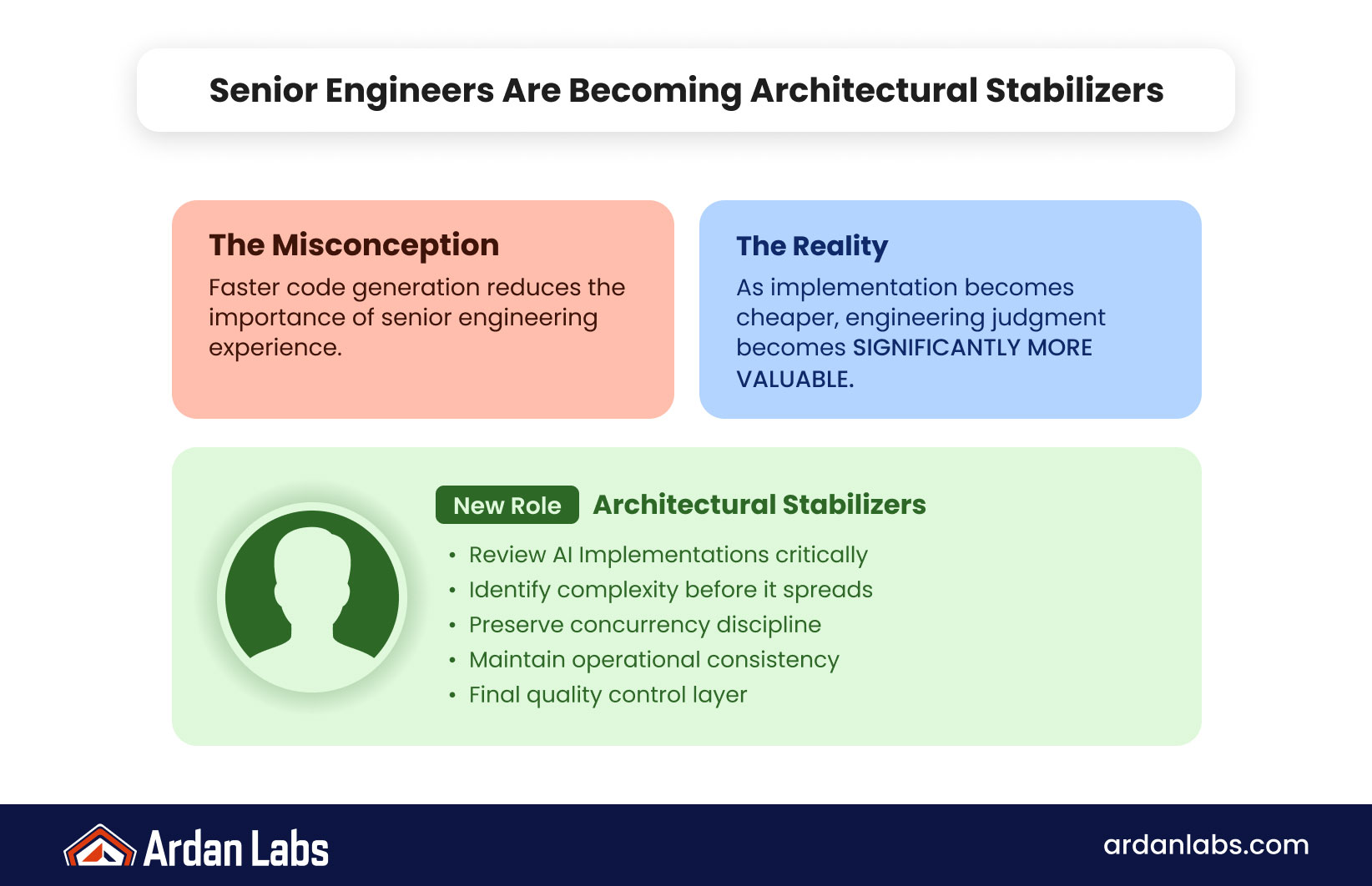
One of the biggest misconceptions surrounding AI assisted development is the assumption that faster code generation reduces the importance of senior engineering experience.
In practice, many organizations are discovering the opposite.
As implementation becomes cheaper, engineering judgment becomes significantly more valuable. Because the bottleneck shifts.
The challenge is no longer producing enough code. The challenge is preserving system integrity while large amounts of code are being produced continuously.
This is quietly changing the role senior engineers play inside modern organizations.
Experienced Go engineers increasingly function less like pure implementation contributors and more like architectural stabilizers inside rapidly evolving systems.
Their role now often includes:
- reviewing AI generated implementations critically
- identifying complexity before it spreads system wide
- preserving concurrency discipline across teams
- maintaining operational consistency between services
- protecting long term maintainability under delivery pressure
- ensuring generated patterns align with platform intent
This is a fundamentally different responsibility than simply writing code faster.
Many engineering leaders are already seeing this transition happen organically. Senior engineers spend less time manually implementing every feature from scratch and more time evaluating whether generated implementations preserve the operational qualities the platform depends on long term.
In many organizations, experienced engineers are increasingly becoming the final quality control layer between AI accelerated velocity and production reality.
That shift is redefining what effective augmentation actually means.
Why Traditional Staff Augmentation Models Break Down in the AI Era
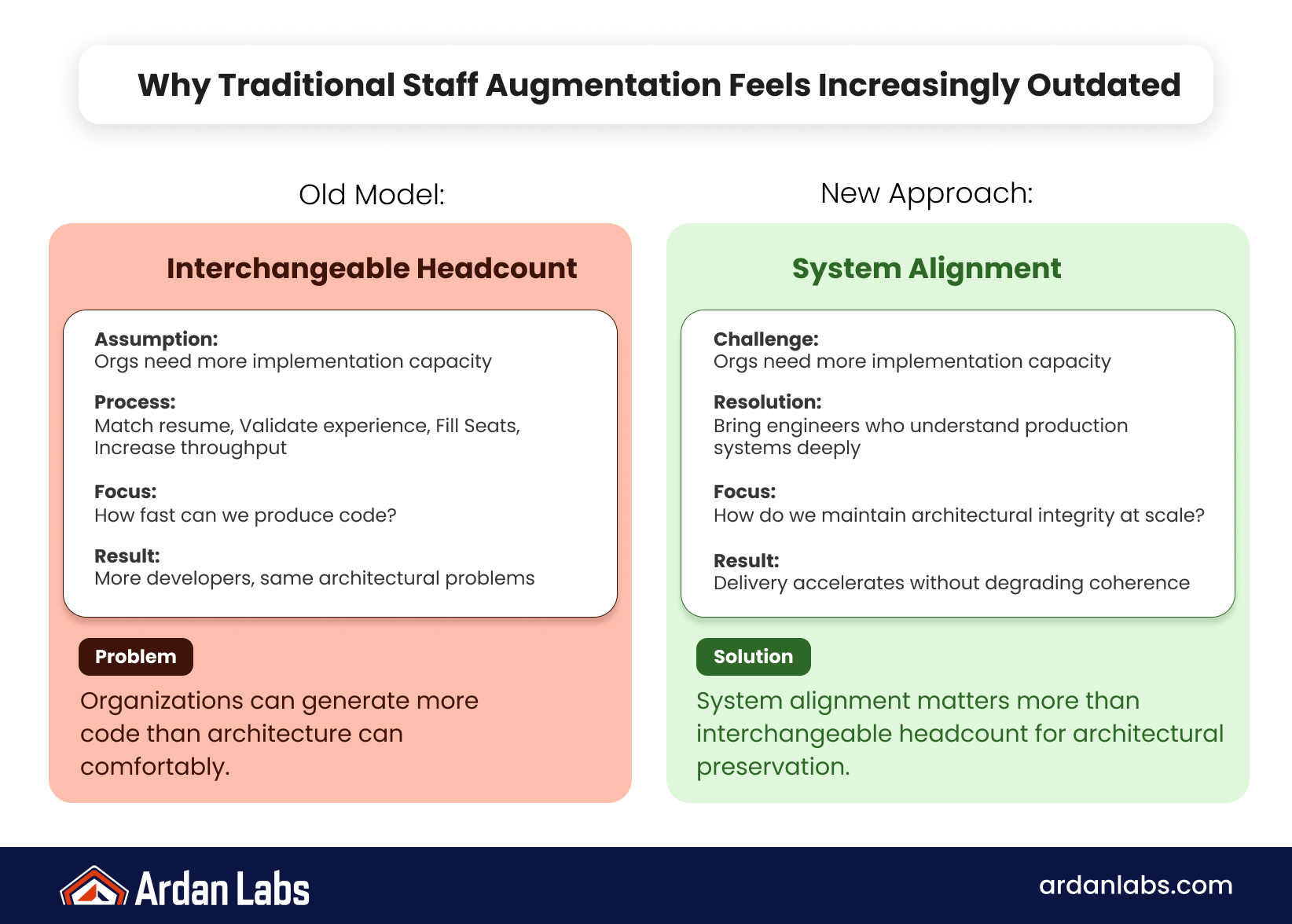
Traditional staff augmentation models were built around one assumption: engineering organizations primarily needed more implementation capacity.
The process reflected that mindset:
Match the résumé to the role. Validate years of experience. Fill seats quickly. Increase throughput.
That model made sense when the primary constraint was human implementation speed. But AI changed the nature of the constraint itself.
Today, many engineering organizations can generate more implementation work than their architecture can comfortably absorb. This creates a fundamentally different staffing problem.
The challenge is no longer:
“How do we add developers faster?”
The challenge is:
“How do we increase delivery velocity without degrading operational coherence across the platform?”
Those are entirely different problems.
An engineer capable of generating large amounts of Go code is no longer especially rare. AI already amplifies that capability across most teams.
An engineer capable of preserving simplicity, operational consistency, concurrency discipline, and maintainability inside fast moving production systems is far rarer.
That distinction is increasingly shaping how CTOs evaluate technical partnerships.
Because architectural degradation compounds financially over time.
Organizations eventually begin experiencing:
- slower onboarding across engineering teams
- rising review overhead and governance complexity
- increased infrastructure inefficiency
- declining confidence in production changes
- reduced ability to evolve systems safely
- growing operational fragility during scale events
And by the time those symptoms become visible organizationally, the underlying drift has usually been accumulating quietly for months.
What Effective Staff Augmentation Looks Like Now
The strongest augmentation partnerships today are designed around system alignment rather than interchangeable headcount.
The objective is not simply adding more developers to accelerate feature output.
The objective is increasing delivery capacity while preserving the operational characteristics that made the platform successful in the first place.
That requires a much deeper form of integration than traditional augmentation models, that are used by regular staff augmentation vendors, were built to support.
Production Experience Matters More Than Language Familiarity
There is a meaningful difference between engineers who know Go syntax and engineers who have operated Go systems under real production pressure.
The difference is not theoretical knowledge. It is accumulated operational judgment.
Engineers with meaningful production experience have already seen how seemingly harmless implementation decisions compound over time. They have debugged concurrency failures that only appeared under scale. They have untangled abstractions that initially looked clean during review but gradually made systems harder to evolve safely.
That experience changes how engineers evaluate generated code.
They stop asking:
“Does this implementation work?”
And start asking:
- What operational behavior does this create under load?
- How maintainable will this remain six months from now?
- Does this align with the platform’s existing architectural model?
- What complexity is being introduced unnecessarily?
- How will this affect future engineers working inside the system?
That shift in perspective becomes increasingly valuable as implementation velocity accelerates.
Context Transfer Is Becoming More Important Than Onboarding
Many augmentation engagements fail not because the engineers lack technical ability, but because the system’s architectural context never gets transferred clearly.
This becomes especially dangerous in AI assisted environments because generated implementations naturally inherit the assumptions of whoever prompted them. Without shared architectural standards, teams begin producing structurally inconsistent systems surprisingly quickly.
Strong augmentation partnerships solve this upfront.
Augmented engineers understand:
- Why Go was chosen for the platform
- Which operational constraints matter most
- How concurrency is approached internally
- What abstractions the organization intentionally avoids
- How maintainability is evaluated across repositories
- What long term platform evolution is expected to look like
That alignment dramatically reduces fragmentation because engineers begin contributing from the same architectural mental model before implementation work starts.
The Best Engineers Reduce Complexity Instead of Creating It
One of the clearest indicators of engineering maturity is the ability to simplify systems under pressure rather than complicate them. This matters even more now because AI naturally increases the amount of implementation surface area organizations can produce.
Teams can build more than ever before. But more implementation does not automatically create healthier systems.
In fact, many organizations are beginning to realize the opposite. As output increases, simplicity becomes more strategically important because complexity compounds operationally over time.
Experienced Go engineers understand that the goal is not maximizing abstraction or sophistication. The goal is preserving clarity. That often means resisting architecture that technically works but introduces long term cognitive overhead the system does not actually need.
The best augmented engineers contribute by reducing entropy inside the platform, not just adding functionality to it.
The CTO Shift Happening Across the Industry
A growing number of engineering leaders are arriving at the same realization independently.
AI dramatically improved local engineering velocity. But it also increased the amount of architectural governance required to keep systems healthy long term.
That realization is reshaping how organizations think about:
- Technical leadership
- Senior engineering roles
- Code review standards
- Architectural governance
- Platform consistency
- Augmentation strategy
The highest leverage engineers are increasingly the ones capable of preserving operational clarity while development accelerates around them.
Because eventually every organization reaches the same point:
The limiting factor stops being implementation speed and becomes organizational coherence.
The systems that scale successfully over the next decade will likely not be the ones generating the most code.
They will be the ones capable of evolving rapidly without losing architectural integrity in the process.
The Future of Staff Augmentation
The future of augmentation is not about supplying interchangeable developers to increase short term output.
It is about introducing experienced engineering judgment into systems evolving faster than internal governance alone can comfortably manage.
That is particularly true in Go environments where simplicity, concurrency discipline, and operational clarity are foundational to long term scalability.
AI will continue accelerating implementation dramatically.
But preserving coherent systems under that acceleration still depends on engineers who understand how production systems behave under real operational pressure.

Experienced Engineers in the AI Era
That is why experienced Go engineers remain strategically important in the AI era.
Not because they type faster than AI. Because they recognize what should never have been generated in the first place.
At Ardan Labs, we approach staff augmentation through that lens: helping organizations scale delivery while preserving the operational clarity, maintainability, and architectural consistency modern systems increasingly struggle to protect.
Frequently Asked Questions
AI has dramatically increased implementation speed across engineering organizations, but it has also increased the risk of architectural drift. Teams can generate more code faster than ever before, yet many CTOs are discovering that systems become harder to reason about when operational consistency and architectural governance do not scale alongside delivery velocity.
Architectural drift happens when systems gradually lose consistency over time through small implementation differences that compound across teams and repositories. In AI assisted environments, generated code can unintentionally introduce inconsistent concurrency patterns, duplicated abstractions, fragmented service boundaries, and operational complexity faster than organizations can govern them.
Go is intentionally designed around simplicity, explicit behavior, and operational clarity. Because the language encourages straightforward patterns and minimal abstraction, inconsistencies in concurrency models, ownership boundaries, or service design often become more visible earlier than in more abstracted ecosystems.
AI can generate Go code quickly, but it cannot reliably evaluate long term operational behavior, maintainability, or architectural consistency. Experienced Go engineers provide production systems judgment, helping organizations recognize concurrency risks, reduce unnecessary complexity, and preserve system integrity as development velocity increases.
CTOs should look for engineers with real production systems experience, strong concurrency knowledge, operational awareness, and the ability to preserve architectural clarity under scale. Effective augmentation partners should also prioritize context transfer, maintainability standards, and alignment with the organization's existing engineering philosophy.
AI can generate concurrency patterns that appear correct during development but create instability under production conditions. Issues involving goroutine lifecycle management, cancellation boundaries, retry behavior, and ownership models often emerge later under real traffic and operational stress. Experienced Go engineers help identify these risks before they compound.
As implementation becomes faster and cheaper through AI, the bottleneck shifts from code generation to system governance and architectural decision making. Engineering judgment becomes more valuable because organizations need experienced engineers who can evaluate generated code critically, preserve platform consistency, and prevent long term operational degradation.
Common signs include inconsistent service behavior, fragmented concurrency models, duplicated infrastructure logic, rising review overhead, declining confidence in production changes, and systems becoming harder to evolve safely over time. These issues often emerge gradually even while delivery velocity appears strong.
Organizations can scale effectively by prioritizing architectural alignment, operational consistency, and experienced engineering oversight alongside implementation speed. Strong systems require shared concurrency standards, maintainability practices, clear platform boundaries, and engineers capable of reducing complexity rather than introducing unnecessary abstraction.