
Every Enterprise Now Has an AI Initiative. Few Have AI Infrastructure.
Over the last two years, nearly every enterprise engineering org has picked up some version of the same mandate: ship AI features, fast.
A chatbot. A copilot inside an internal tool. A retrieval layer over the knowledge base. An agent that triages support tickets. The pressure to show AI progress has moved from “nice to have” to board-level expectation almost overnight.
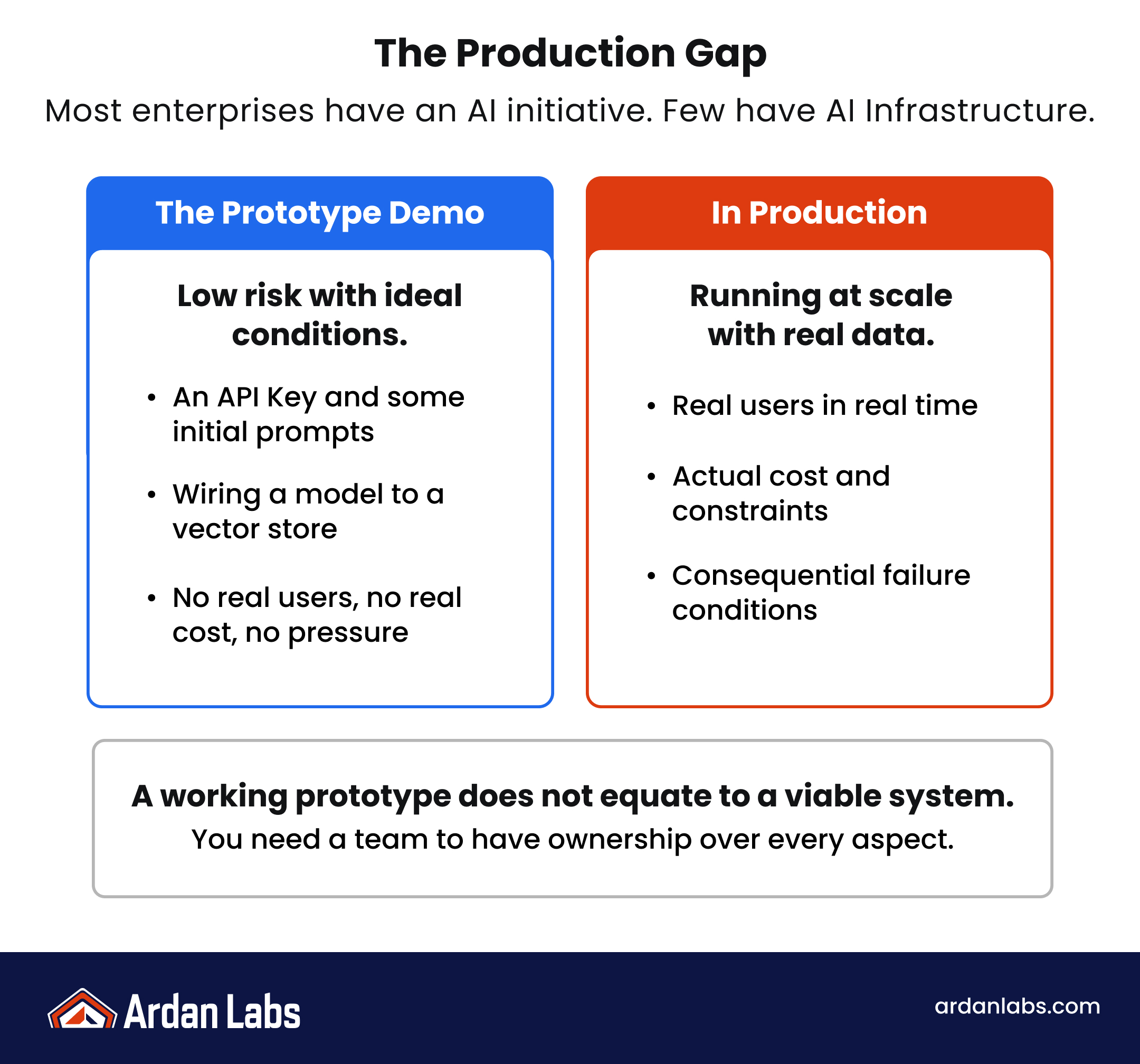
Getting a demo working is no longer the hard part. Anyone with an API key and a weekend can wire a model to a vector store and produce something that looks impressive in a meeting.
Running that same system in production, at scale, under real users, real cost constraints, and real failure conditions is a completely different problem.
That gap, between demoing AI and operating AI, is where a growing number of enterprises are quietly stuck.
They have a working prototype. They do not have a team that can own it.
The Skills Gap Nobody Budgeted For
Most hiring plans for “AI engineers” were written before anyone fully understood what the job actually requires once a system reaches production.
The résumé pattern looks familiar: some prompt engineering, a personal project with a popular framework, maybe a certificate from a weekend course. It signals enthusiasm. It does not signal the ability to keep an LLM-backed system stable in front of paying customers.
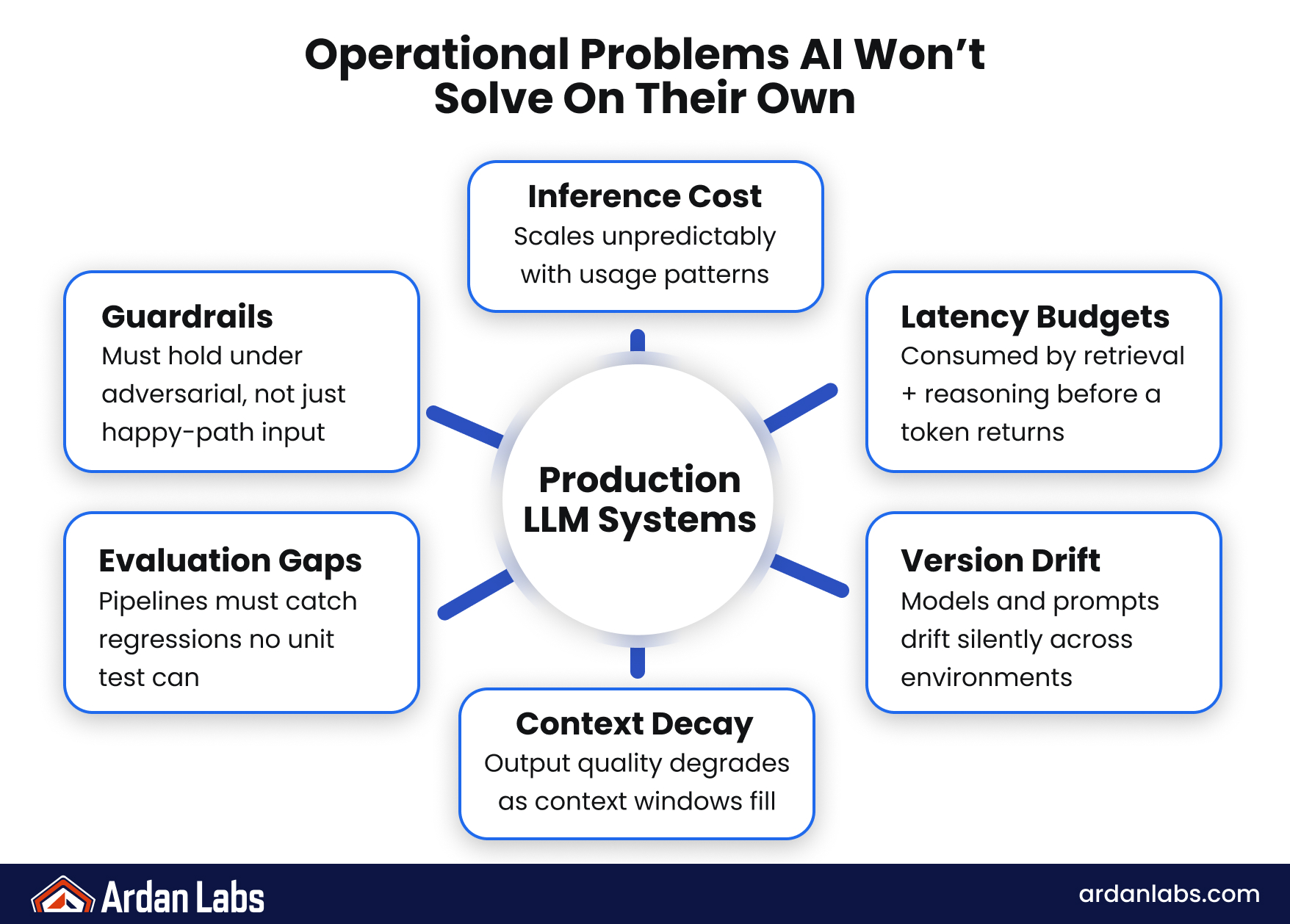
Because production LLM systems introduce an entirely new category of operational problems that traditional software engineering and traditional data science were never built to solve on their own:
- Inference cost that scales unpredictably with usage patterns
- Latency budgets that get consumed by retrieval, reranking, and multi-step reasoning before a single token comes back
- Model and prompt versioning that drifts silently across environments
- Context windows that quietly degrade output quality as they fill
- Evaluation pipelines that have to catch regressions no unit test was ever designed to catch
- Guardrails that need to hold under adversarial and simply careless input, not just happy-path testing
Very few candidates in the current market have operated at the intersection of all of these. Most have depth in one piece, the modeling side, or the infrastructure side, or the prompting side, and a shallow familiarity with the rest.
Enterprises are discovering that the person who can build the demo and the person who can be trusted to own the production system are, more often than not, two different people.
Why LLM Systems Fail Quietly, Not Loudly
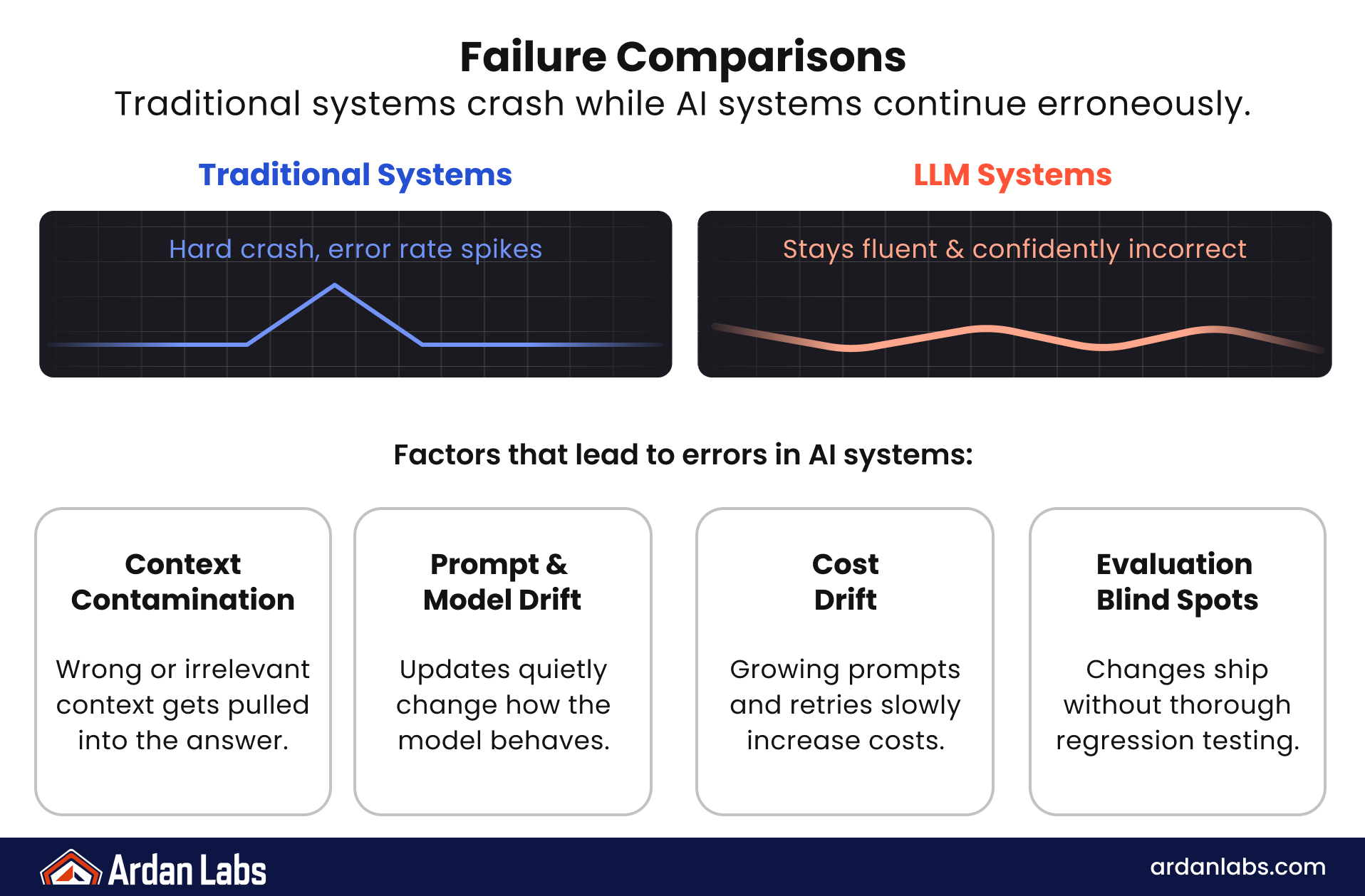
Traditional production incidents tend to announce themselves. A service crashes. A request times out. An error rate spikes on the dashboard everyone is already watching.
LLM systems fail differently. They tend to keep responding. They just start responding wrong, and the wrongness is dressed up in confident, well-formed language.
This is the operational trap at the center of most enterprise AI rollouts: a hallucinated answer reads exactly like a correct one. Plausible logic masks the absence of real context, and nothing in a standard monitoring stack is built to catch that on its own.
The failure modes engineering teams are now expected to detect and contain include:
- Context contamination — retrieval pulling in adjacent, slightly wrong information that a model still stitches into a fluent, wrong answer
- Prompt and model drift — a provider update, a prompt template edit, or a silent model version change shifting behavior without anyone noticing until a customer does
- Cost drift — token usage creeping upward as prompts grow, chains lengthen, and retries stack, until a feature that pencilled out in a pilot quietly stops being economical at scale
- Evaluation blind spots — teams shipping updates against a handful of manually reviewed examples, with no systematic way to catch regressions across the long tail of real usage
None of these show up as a red dashboard. They show up as declining trust, rising support tickets, and a slow erosion of confidence in a system that, on paper, is still “working.”
Catching them requires engineers who think about LLM behavior the way experienced backend engineers think about concurrency: not “does this work when I run it,” but “how does this behave under scale, under edge cases, and under conditions I did not personally test.”
What Actually Makes an Engineer “Production-Ready” for LLM Systems
The strongest LLM infrastructure engineers share a pattern that has very little to do with how many models they can name.
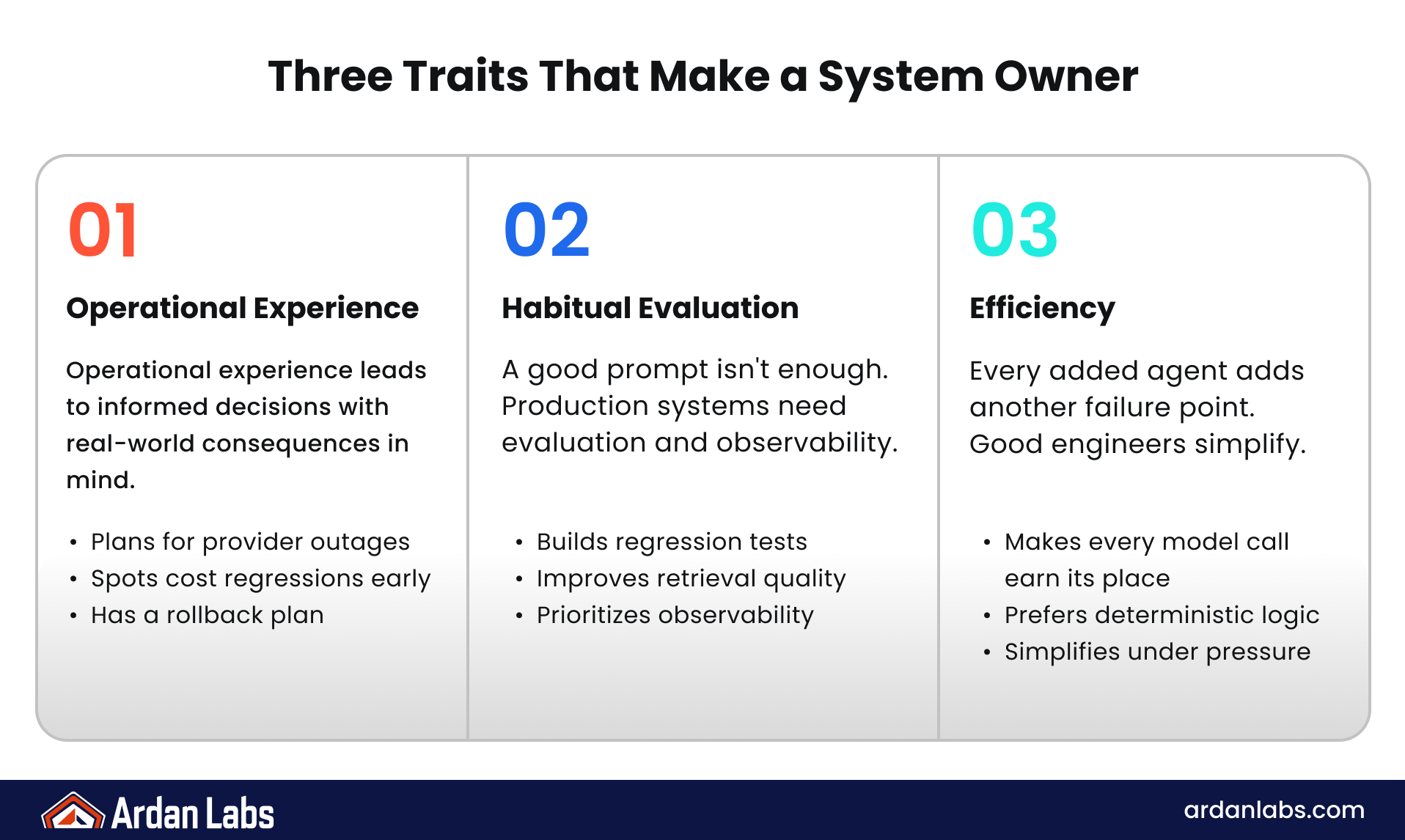
Operational Experience Outweighs Model Trivia
Knowing the differences between model providers, context window sizes, or fine-tuning approaches is table stakes. It is not the differentiator.
The differentiator is whether an engineer has actually operated a system where those choices had real consequences, where a model swap changed latency enough to breach an SLA, or where a context window limit forced a redesign of the retrieval layer under deadline pressure.
That experience changes the questions an engineer asks before shipping:
- What happens to this system when the model provider has an outage or a silent behavior change?
- What does a cost regression look like, and how would we catch it before finance does?
- How do we know an answer is wrong when it sounds completely right?
- What is our rollback plan when an evaluation catches a regression after deployment?
Those are systems-engineering questions wearing an AI costume. Engineers who have only worked at the prompting layer rarely ask them, because they have never had to answer for the consequences.
Context and Evaluation Infrastructure Matter More Than Prompt Tuning
Enterprises frequently over-invest in prompt engineering and under-invest in the infrastructure that makes prompts trustworthy at scale: retrieval quality, evaluation harnesses, observability, and guardrails.
A well-tuned prompt with no evaluation pipeline behind it is a demo. A modest prompt backed by real retrieval quality checks, automated regression evaluation, and production observability is a product.
Engineers who understand this distinction spend their time differently. They build the scaffolding that lets a system improve safely over time, instead of hand-tuning a prompt that will quietly break the next time the underlying data shifts.
The Best Engineers Reduce Surface Area, Not Add to It
There is a strong temptation in AI projects to solve every new problem by adding another agent, another chain step, another model call. Each addition feels like progress. Each addition also adds another place the system can fail silently, another cost multiplier, and another layer of latency.
Experienced engineers push in the opposite direction. They ask what can be removed, simplified, or handled deterministically instead of being routed through another model call. They treat every additional LLM invocation as a liability that has to earn its place, not a default tool reached for by habit.
That instinct, reducing complexity instead of accumulating it, is exactly the same judgment that separates senior engineers from junior ones in traditional backend systems. AI infrastructure has not changed that principle. It has just raised the stakes.
Why Traditional Staff Augmentation Models Can’t Fill This Role
Traditional staff augmentation was built to solve a resourcing problem: match a résumé to a role, validate years of experience in a named technology, and fill the seat.
That model assumes the skill being staffed for is well-defined and reasonably mature in the market. LLM infrastructure is neither. The discipline is barely two years old in its current form, the tooling is still shifting quarter to quarter, and the job title on a résumé tells you almost nothing about whether someone has actually operated one of these systems under real conditions.
Résumé-matching for “AI engineer” roles right now mostly filters for enthusiasm and keyword familiarity. It does not filter for the engineer who has debugged a cost regression at 2 a.m., who has built an evaluation pipeline that caught a regression before customers did, or who instinctively distrusts a plausible-sounding output enough to check it.
That is a fundamentally different hiring problem than the one traditional augmentation vendors were built to solve, and it is why so many enterprises end up with contractors who can extend a demo but cannot be trusted to own a production system.
The CTO Shift Happening Across the Industry
Engineering leaders are converging on the same realization from different directions: shipping an AI feature and operating an AI system are not the same job, and treating them as the same job is how enterprises end up with unreliable, expensive, and slowly trust-eroding AI products.
That realization is reshaping how CTOs think about:
- What “AI engineer” actually needs to mean on a job requisition
- Where evaluation and observability sit in the delivery pipeline, not as an afterthought but as a first-class requirement
- How much production systems experience should be weighted against AI-specific tooling familiarity
- Whether augmentation partners are staffing for demos or staffing for operational ownership
The organizations getting this right are not necessarily the ones with the most advanced models. They are the ones with engineers who bring the same operational discipline to LLM systems that experienced teams already bring to distributed backend systems — because underneath the new tooling, it is still a systems-engineering problem.
The Future of Staff Augmentation for AI Systems
The next phase of enterprise AI will not be won by whichever team ships the most agents the fastest. It will be won by the teams that can keep what they ship reliable, cost-effective, and trustworthy once real users are depending on it.
That requires a different kind of augmentation than the market has mostly offered so far: engineers who bring production systems judgment to LLM infrastructure, not just familiarity with the latest framework.
AI will keep making it easier to build the first version of something. It will not make it easier to operate that system responsibly at scale. That still depends on engineers who know the difference — and who have the production experience to prove it.

Engineers Who Can Actually Ship LLM Systems
That is the gap Ardan Labs engineers are built to close: not another demo, but AI infrastructure that holds up under real production pressure, reliable retrieval, real evaluation pipelines, cost discipline, and the operational judgment to know when not to add another model call.
At Ardan Labs, we approach Staff Augmentation for AI systems the same way we approach it for any production platform: engineers who can be trusted to own outcomes, not just implement features.
Frequently Asked Questions
It is staff augmentation focused specifically on the engineers required to operate LLM-backed systems in production — covering retrieval quality, evaluation pipelines, cost management, observability, and guardrails — rather than general AI feature development.
Most candidates in the current market have experience building demos or prototypes, not operating LLM systems under real traffic, cost constraints, and failure conditions. Production readiness requires operational judgment that résumé keywords don't reliably signal.
LLM systems tend to fail quietly rather than loudly. Instead of crashing or throwing errors, they keep responding, but the responses become subtly wrong. Hallucinated or drifted outputs often sound just as confident and fluent as correct ones, which makes the failure hard to detect with traditional monitoring.
Drift happens when a model provider update, a prompt template change, or shifting underlying data causes a system's behavior to change without anyone noticing. Without evaluation infrastructure in place, these regressions often surface only after they've affected real users.
A well-crafted prompt with no evaluation pipeline behind it can't be trusted to remain accurate as data and usage evolve. Evaluation infrastructure and observability let teams catch regressions systematically, rather than relying on manual spot checks.
CTOs should look for engineers with real production systems experience — not just AI tooling familiarity — including a track record of managing cost, latency, evaluation, and reliability under actual production conditions, and the judgment to reduce system complexity rather than add to it.
Every additional agent, chain step, or model call adds a new place for a system to fail silently, along with added cost and latency. Experienced engineers treat each additional LLM invocation as a liability that must earn its place, favoring simpler, more deterministic solutions where possible.
Traditional staff augmentation matches résumés to well-defined, mature roles. LLM infrastructure is a young and fast-moving discipline where job titles reveal little about real operational experience, making résumé-matching alone an unreliable way to staff for it.